
Is your dream of work-life balance actually harming you?
The Pursuit of a Dream
One of the most common personal development goals we see leaders choosing in a post-Covid world is:
- “Improve work-life balance”
As you can probably guess, no one is saying they need to increase their working time.
One client told us, “A 60-hour work week would feel like a holiday” compared to what she usually puts in.
There are objective, external forces at work that deserve recognition.
Mounting pressures affecting many of our clients’ work hours include:
- Distributed global teams: translates into 15+ hours of “on time” each day from very early in the morning until late at night to accommodate different time zones.
- Quickly fluctuating market conditions: translates into suddenly needing to solve difficult, unforeseen problems.
- Leaner teams: translates into fewer people handling the same (or increased) workload.
- Fierce competition: translates into more strategy meetings to “stay ahead” of the other company / technology / school / model / etc.
- Intensified stakeholder demands: translates into giving more updates and feeling “on call.”
Now, when we say work-life balance we certainly don’t mean equal time spent at work and away from work. It’s not about the numbers, it’s about energy. It’s about feeling grounded, stable, and able to give both your work and your non-work life the needed attention without guilt.
Whether humans are working more or less nowadays is a complex issue that’s hard to measure. But the fact is people feel out of balance. And that feeling of needing to stabilize is real.
There’s a growing sense that the current situation is unsustainable, yet making a change to either side of the equation seems like an impossibility. That makes the whole topic a nightmare.
Should we just give up on the goal? We don’t think so, but we’ll need to dig deeper into the details before we arrive at the solution.
What Exactly Is the Dream?
An unlikely quotation can help frame this discussion. In a classic (now unfindable) clip from the radio show Car Talk, a caller had this “problem” and wanted the two car experts to solve it for him (paraphrased below).
Caller: My problem is I don’t know how to drive a manual transmission. I’ve tried to learn and it seems like it’s just too hard for me.
Expert 1: Why is that a problem? Most cars are automatic these days anyway.
Caller: I know, but I just have this dream of buying a convertible and driving around with the top down. And in my dream, the car is always a stick shift.
Expert 1: You know, sometimes our dreams…
Expert 2: (interrupting) Are nightmares! (all three burst out laughing)
One of our coaches remembers listening to this live and thinking it was so hilariously rude of the experts to solve this “problem” by telling the caller, basically: “You need to give up on this dream.”
But there’s a bizarre sort of truth here. This caller was very upset that he couldn’t achieve a goal he set for himself. He set a bar that was too high and was expending a lot of energy trying to reach it.
The car experts challenged the underlying assumption by asking: do you actually need that?
Work-Life Balance and the 3Cs
If anyone’s still reading this, we’re not trying to tell you that you should give up on your dream for improving work-life balance. On the contrary, feeling more in balance it is essential for your sustained success.
What we are trying to tell you is: you may need to give up on an unrealistic “nightmare” version of your dream that’s either too vague or based on untrue assumptions. That version of your dream may be causing you extra stress and making the work-life balance issue worse than it needs to be.
For example, you may be feeling you don’t spend enough time at home. But what is “enough” exactly? Or you may feel that you’re letting down your team at work when you must engage in essential family activities. But are you?
That’s why this issues is not as simple as getting out an Eisenhower Matrix and plotting urgent/important things. Having a healthy work-life balance given those complex factors listed at the beginning of the article requires an adaptive approach.
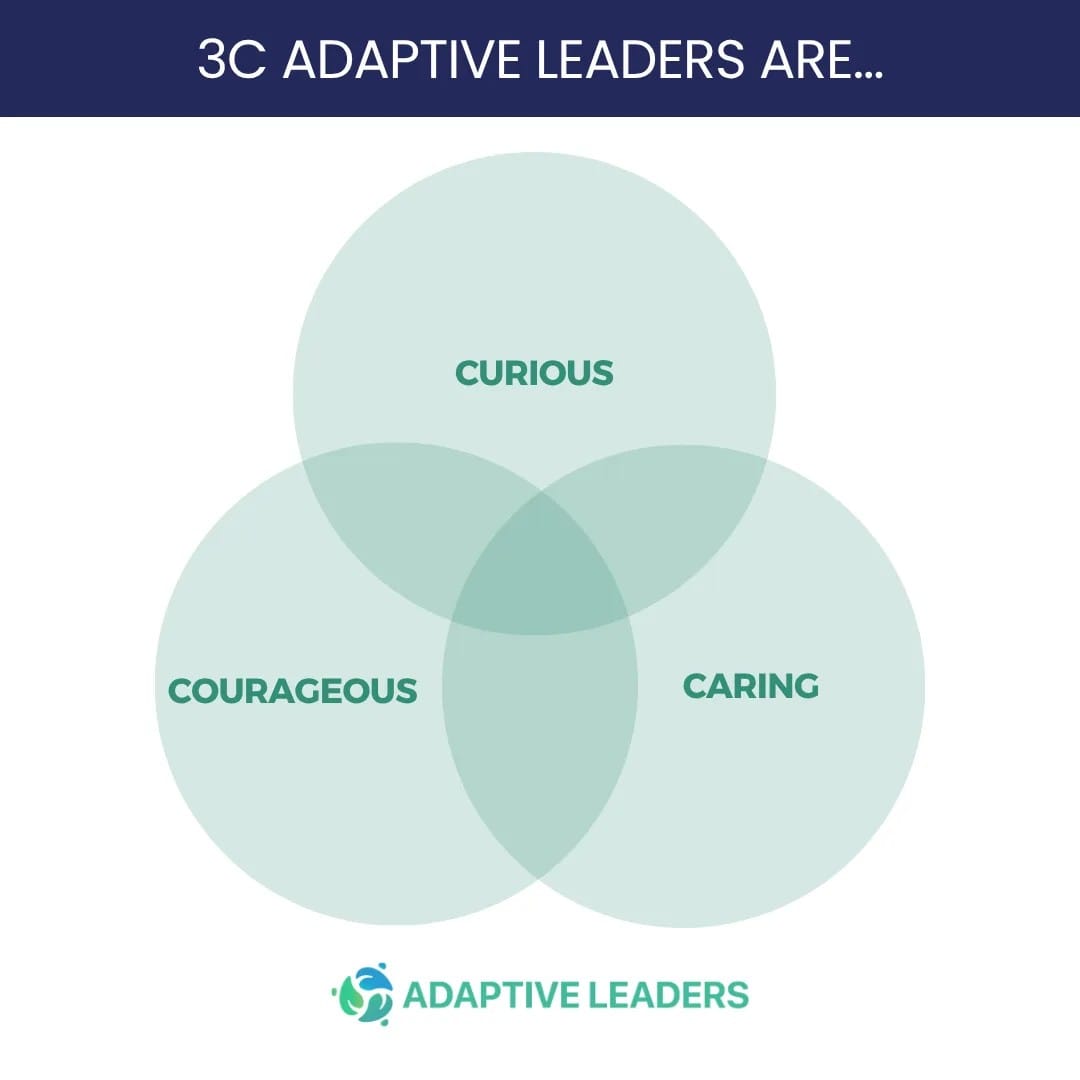
The 3Cs are the solution to this little riddle, but mostly Care. These are the questions you should use anytime your work-life balance requires a tune-up (could be weekly, or even daily for some of us!).
Care
- During this season, how will I care for relationships at work?
- How about relationships in the rest of my life?
- What element of self-care is missing right now?
- What am I willing to change to demonstrate care to myself and others during this season?
Notice we’re focusing on the current “season.” That’s honestly one of the best hacks for work-life balance: naming the current season.
And by the way, there’s often a temptation to define “season” based on work: current project, fiscal period, milestones, etc. But don’t forget you’re a whole person who has incalculable value outside of your work identity. Your non-work life deserves a seat at the season-setting table too: moving house, kids’ ages and needs, parents’ health, etc.
Once you have a more clearly defined sense of your current season, and how you want to care for these essential relationships, you can start to get more specific with the other 2 Cs.
Curiosity
- What am I assuming about work-life balance that might not be completely true?
- What are the most important factors in a healthy work-life balance for me?
- How will I know I’ve achieved a healthy work-life balance?
- What are the downsides to achieving a healthy work-life balance that might be keeping me from perusing it?
Courage
- What difficult questions or conversations do I need to engage in to improve my work-life balance?
- Who am I worried about disappointing if I make an adjustment? What information am I missing there?
- How am I comparing myself to others that might be damaging my sense of balance?
- Where is any guilt I’m feeling about my work-life balance really coming from?
- What hard truths about my identity might I need to face if I’m going to improve my work-life balance?
It’s a Deep One
As you may sense, this rabbit hole goes as deep as you’re willing to follow it. For most of us, work-life balance isn’t as simple anymore as working 9 to 5 and then clocking back in Monday morning. But an adaptive approach using the 3Cs can give you immediate gains where you may have felt helpless before.
It will, however, require a bit of reflection to find that one little change you can make as soon as possible so you can see the issue from a new angle.
If you activate Care, Curiosity, and Courage beyond your default levels, you might be surprised at what’s possible.
The Adaptive Accelerator™
This is exactly the sort of exciting, deep work we do with leaders in our free 1-hour Adaptive Accelerator™ program. If you’d like to make a fast and lasting change to flex your adaptivity, join us online or in person near you.
Next Steps?
Not quite ready for the whole experience? Try our 3-minute free Adaptive Snapshot for immediate insight and specific advice on your own 3Cs.