
In international schools, the average Head of School tenure is less than 4 years. Laurie McLellan lasted 18 years at the same school. The difference, he says, came down to a critical year he wasn’t working.
The story is so compelling that we’re taking a break from our normal article format to share our in-depth conversation with Laurie.
- Terminology note: In international schools, the top role carries different titles depending on the institution: Head of School, School Director, Executive Director. In this article we use them interchangeably.
The Numbers Tell a Story
Laurie McLellan arrived at Nanjing International School (NIS) in 2009 as the director of one of China’s most distinctive international schools. NIS is the oldest international school in Nanjing, the first IB Continuum school in China, and the city’s only independent non-profit institution. He was good at his job, his community trusted him, and if he had followed the trend, he would have made a graceful exit after six years.
“I was absolutely exhausted,” he recalls.
By his fifth year, he had already beaten the industry average tenure for heads of school, but he was eyeing the door.
He was considering the only option he was aware of: finishing out his contract and then taking a year off to recover.
“I loved the school, and my family loved living in China. But I knew I had, at most, one more three-year contract in me.”
This is the story of how he came to stay another 12 years. The short answer: his board made him an offer he couldn’t refuse.
The longer answer involves deep and trusting relationships, a governance consultant who had lived it himself, a Deputy Director who proved she was ready for more than anyone expected, and a year in Edinburgh that Laurie describes as “the most restorative of my professional life.”
Listen to the conversation: Episode 10 of The Adaptive Journey wherever you get your podcasts.
Why Is Nobody Talking About This?
In almost every sector, sabbatical culture is thin. Only about 7% of companies globally offer any form of paid extended leave (SHRM, 2023, cited in Morse & Burleigh, 2024), with a few famous exceptions, including McDonald’s and Deloitte. In universities, sabbaticals are usually framed as a break from one kind of work to do another.
In international schools, sabbaticals are virtually non-existent as a deliberate institutional policy. The default pattern, as Laurie describes it, is blunter:
“When it’s time to really take some time out, people tend to take a year after they leave their job and before looking for the next opportunity.”
This is the working gap year: the leader resigns, recovers while living on savings for 12 months, and then resurfaces in the market. The major difference between a working gap year and a sabbatical is pay and the expectation of return. Sabbaticals are compensated, and then you come back to the same post.
After his sabbatical year, Laurie and NIS Board Chair Julia Güsten ran a session on the topic at the EARCOS Leadership Conference. Only about a dozen people attended.
“That was a good indicator that this is really not in people’s sphere of thought.”
All these years later, Laurie is still aware of only three other people in his industry who have taken a proper sabbatical.
The Conditions Have to Be Right
Before any conversation about a sabbatical can happen, several things must be in place.
1. Strong mutual trust with the board, especially the chair
Boards turn over. Chairs rotate. In Laurie’s story, his board chair, Julia, committed to staying on the board through his sabbatical year and his first year back as a formal part of the agreement.
“I don’t even know how many school heads develop those kinds of relationships with their board chairs, or have board chairs who are able to spend quite a long time in that position.”
2. Deep institutional relationships
There must be a certain level of confidence before a community can release its head for a year. Students, teachers, and parents must genuinely know and trust the person.
“It takes five or six years to reach that space, if ever.”
3. A school that can stand on its own
“I think the school has to have a sense that it’s a stable institution.”
Laurie says the school needs to feel secure in itself: financially well-managed, with a sense of history and continuity that doesn’t depend entirely on the person in the director’s chair.
Where Did the Idea Come From?
At the end of Laurie’s fifth year at NIS, a committee was convened to negotiate his next contract. By then, governance consultant John Littleford had built relationships not just with Laurie, but also with Julia, the Board Chair. But Littleford’s approach went well beyond governance.
“He builds a relationship with the school director and also with the family, including my wife, Jenny. And to this day, if you met John, he would remember the names of my sons and what they’re doing. He was very much about you, not just as a leader but as a person.”
As Littleford continued that conversation with Laurie, the picture was clear: Laurie was tired. He had told the board he would do one more three-year contract and then he and Jenny would take a break.
Littleford and Julia likely discussed this between themselves: Laurie loves this school, but he’s tired. And tired, it turns out, has a solution. One that Littleford himself had experienced earlier in his career.
The Offer
Laurie went into the meeting with the committee expecting to negotiate a final three-year contract. What he heard instead was: “NIS would like to offer you a five-year contract…”
He was slightly annoyed that the board hadn’t been listening when he said he would only be able to last three more years.
“…and year two of that contract would be a sabbatical.”
Laurie was stunned.
When the room finished talking through the practicalities, he had only one response: “I think I need to speak to Jenny.”
The committee burst out laughing. Their response: “We think so too.”
Laurie was deeply touched. “That they would have that much faith in me, that they were prepared to go out on a limb and make an offer of that magnitude. I already felt a sense of dedication and connection with the school. But from that moment, my loyalty just went from high to through the roof.”
This is the retention math that boards may miss: not just whether the offer is affordable financially, which we’ll get to next, but what it returns in loyalty.
The Raw Business Case for a Sabbatical
Retention. Laurie’s sabbatical was embedded in year two of a five-year contract. After returning, he stayed a further decade. His total tenure: 18 years at one school. The industry average sits between 2.8 and 3.7 years (Baker 2026; Hawley, 1994, 1995, cited in Gibson & Bailey, 2021; Benson, 2011). The cost of replacing an exceptional leader dwarfs the cost of a one-year leave arrangement, even at full salary.
Cost reduction. Laurie worked with the board to find a cost-neutral solution. By taking 50% salary himself, he freed up resources to cover the acting Director’s stipend. “I don’t want people to think a sabbatical means two director-level salaries. It doesn’t have to work that way at all.” The financial models are more flexible than boards may assume.
Performance quality. Laurie is direct about what chronic fatigue does to a leader’s work: “You’re probably relying on things you’ve done in the past that people cut you a bit of slack on. You’re not working as well.” An oversimplified but easy way to think about this is that a leader running at 75% for four years accumulates the equivalent of a full year of lost performance.
Succession development. A sabbatical creates a forced, structured opportunity to develop the next generation of leadership. When Arden Tyoschin stepped into the director role for that year, others also had to shift their responsibilities. The entire system underwent a “safe” stress test because everyone knew Laurie would be coming back. At the same time, everyone had to step up and take a new level of ownership.
Practically Making It Work
The practicalities matter, and two decisions shaped everything.
First, Laurie enrolled in an MSc in Inclusive Education at the University of Edinburgh, a direct investment in a strategic priority the school was already pursuing.
“It was really important to me that I had something I was going to do that brought more value than ‘Laurie is tired.’ As heads of school, you’re already well paid. The school community should feel a value beyond just that.”
Second, the Deputy Director became the Director. Not interim. Not acting. Arden Tyoschin moved into Laurie’s office. The symbolism mattered. They agreed to check in quarterly, always looking backward at decisions already made, never forward for advice on what was coming.
Arden says this was key to her success. “I didn’t feel like I needed to check in on strategy. I actually wasn’t allowed to ask for advice. Laurie told me, ‘You can’t be second-guessing yourself about whether I would approve.’”
What Arden encountered in her first three months would have tested any leader: a fire on campus, a colleague who died, an internal petition against the formal dress code, and a major issue with a board member. Some directors serve for years without facing a single one of those. Arden faced all four before December.
She used her experience as Director for that year to successfully land two successive headships following her time at NIS.
The Restorative Year
While in Scotland, Laurie walked his Labrador through a large park in the center of Edinburgh every morning at six o’clock. He attended live music and theater. He reconnected with family he hadn’t lived near since he was 18. He sorted out banking, legal paperwork, and important administrative tasks he’d been deferring for years. He also had knee surgery he’d been putting off.
He also enjoyed being a full-time student for the first time in decades, which gave him special empathy for his high school students back in Nanjing. Additionally, he maintained his role as President of the Board of Trustees of the Council of International Schools, which kept him connected to international education at a different register.
On the surface, it may not look all that restful, but to Laurie, “it was a really rejuvenating experience.”
The Payoff
Re-entry was warm. NIS parents stopped him in corridors to ask about his studies. But the thing Laurie wasn’t prepared for was how many people told him how well he looked.
“I lost a bit of weight. I was way fitter. I had a completely different energy level. When I went to my first EARCOS conference, people from all over were saying, ‘Laurie, you look completely different.’ You can’t really see that in yourself.”
It turns out the knee surgery was symbolic of the whole experience. Having the time to get the surgery enabled him to get more exercise afterward. The sabbatical turned a vicious cycle into a virtuous one.
“As humans, we have an incredible capacity to just live with the limp and the pain. And it’s only when it gets really intense that we feel like it bothers us.”
Leaders who need a sabbatical often don’t know how much they need it for exactly the same reason. The compensation is so practiced that the original level of vitality becomes genuinely hard to remember. You stop knowing what you’re missing.
Laurie returned to NIS in 2017, and his final contract there ends in 2027. The sabbatical, in retrospect, was not a pause in his tenure. It was the investment that made the second, longer part of it possible.
Rejuvenation and the 3Cs
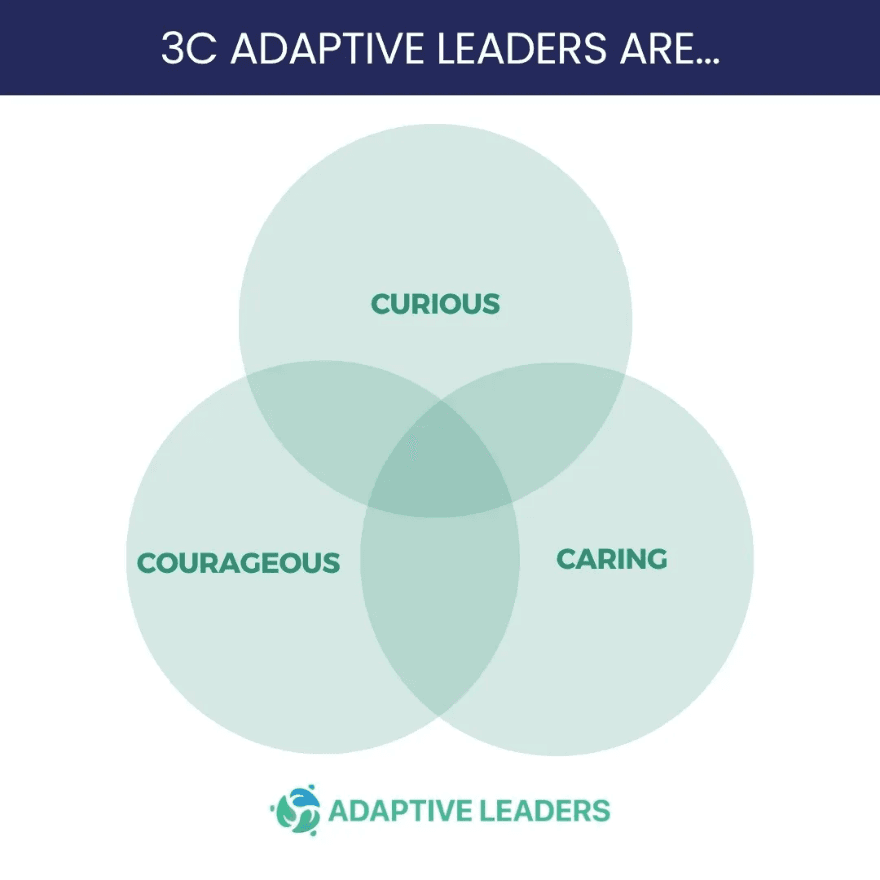
At Adaptive Leaders, we usually apply our 3Cs (Curiosity, Courage, and Care) to how leaders lead others. Laurie’s story asks us to turn them inward.
Here is the part that is easy to miss: Laurie didn’t rescue himself. He’d told the board he’d do one more contract and leave. It was John Littleford who saw what Laurie couldn’t yet name, and carried it to the board for him.
If you have a John in your life (a board chair, a mentor, someone who sees the person and not just the performance) treasure them. They are rare.
Most leaders don’t have one. So the harder question is this: what do you do when no one is going to name it for you?
You can’t be your own John entirely. Part of his gift was that he saw from the outside what Laurie couldn’t see from within. But you can do the first part. You can notice and name it, which may help a John find you.
The 3Cs are how you start.
Curiosity: Ask yourself the question a John would ask
You are the worst-placed person to see your own depletion. You’re used to your limp. So get curious on purpose. Not “should I leave?” but the questions underneath it: what, exactly, has run dry? The job, or you? A season? The whole thing?
Laurie loved the work. He was simply empty. Naming that difference might change everything.
Courage: Say the quiet thing, even if you have to say it first
Laurie’s turning point was someone willing to say “Laurie is tired” out loud. If no one says it for you, the courageous act is to say it yourself. Saying you’re running low can feel like admitting weakness but it doesn’t have to be. It can be the most courageous thing a leader can do.
Saying it out loud is also how you let someone in. The leaders who find their John are usually the ones who first found the courage to admit they needed one.
Care: Act on what you’ve named
Noticing isn’t enough. John didn’t just see that Laurie was tired, he did something with it. Caring for yourself isn’t indulgence. It’s taking the truth you’ve admitted and doing something real with it. A conversation. A boundary. A request. Sometimes, like Laurie, a year away. The form matters less than the fact that you stopped pretending the limp wasn’t there.
The Equity Angle
These 3C suggestions may land differently for men and women. The other three leaders Laurie knows personally who have taken a structured sabbatical are men. CIS research consistently finds that female international school heads are paid less than their male counterparts (CIS, 2025) and Laurie worries that women will not feel as free to advocate for their own wellness.
A more equitable approach is for boards to make a more holistic conversation about wellness a standard part of the evaluation and goal-setting process, not a special negotiation with an individual head. Maybe advocating for that should be your first step.
Surprises
When Laurie came back, things were different. Everyone was surprised to see Laurie crackling with health and vitality. And Laurie was surprised to learn that Arden had taken his own instructions to heart and changed the highly formal dress code he prized.
She recalls, “When Laurie found out, he sort of rolled his eyes and said ‘okay.’”
Laurie himself now wears running shoes to work.

Laurie McLellan is the incoming Executive Director of EARCOS (East Asia Regional Council of Schools), beginning in August 2027. He served as School Director of Nanjing International School from 2009 to 2027.
Albert Wolfe is a leadership coach and writer at Adaptive Leaders.
The Adaptive Leader Studio™
Exploring Curiosity, Courage, and Care is a major part of the exciting, deep work you can scale to your whole organization with our Adaptive Leader Studio. Get started today.