
What is the most important thing for you to improve about yourself?
Story
A leadership team was excited to join the Adaptive Leader Journey, but when they went to choose a personal improvement goal, it turned out to be more difficult than they expected.
Improvement goals are stated like this:
“I want to get better at…”
It should be something:
- High impact (this would make a huge difference to your work)
- Important for you (something you can do and agree is important, not just something your boss told you to change)
- Continuous improvement (you never totally “achieve” it)
- Difficult to change (otherwise you would have done it already)
But many of them still chose goals that didn’t have 4 out of 4 of those requirements.
- “Onboarding a new teammate” – not difficult/continuous enough
- “Hitting my KPIs this quarter” – not continuous enough
- “Behaving the way my supervisor told me to” – not important enough to you
- “Learning more about the industry” – not enough high impact
Those were all good goals, but for an improvement goal we were looking for the single most important thing for each of them to improve.
It’s a good thing our coach was doing a verbal 360 review with their supervisors, direct reports, and colleagues.
Getting Input
When trying to improve your own leadership, it’s crucial to choose the right goal for your current season. That’s why getting input from your colleagues is essential. Other people see things you don’t. But even if the 360 review doesn’t reveal blind spots, the input can provide useful confirmation that you’ve chosen the right goal.
Don’t forget you can run your own 360 anytime.
80/20 Rule for Improvement Goals
Let’s play that old party game, “Would you rather…”
- “…make huge progress on a low-impact goal”
or - “…make a little progress on a high-impact goal?”
And a follow up question: Which would your supervisor rather have from you?
You guessed it: the high-impact goal wins every time.
We can use the amazing 80/20 rule to help you focus on the improvement goal that will make the most impact.
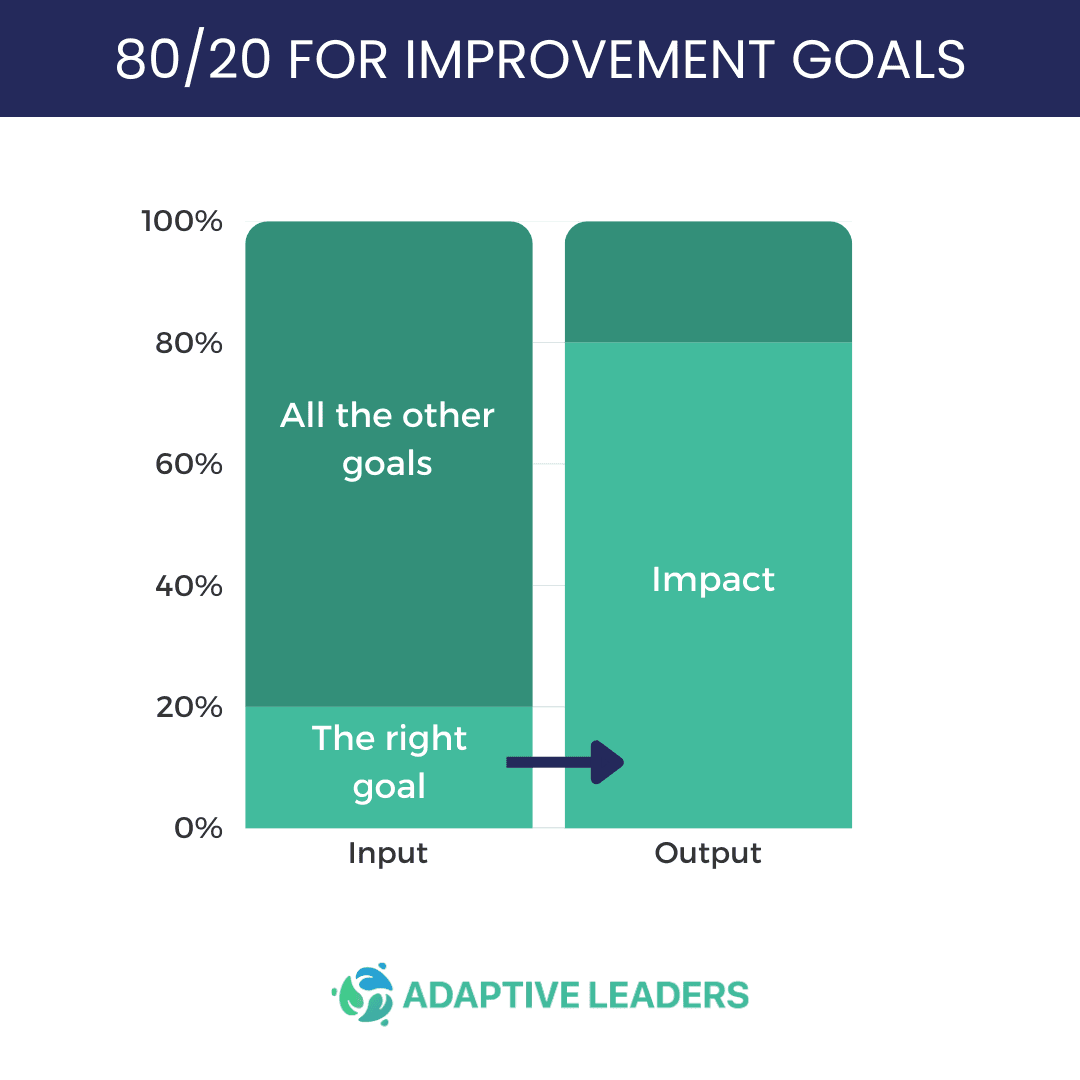
One question to ask yourself (or others) is:
- If I could only improve this one thing about my leadership, would it make the hugest impact?
Impact on what? Usually, we’re looking at impact on one or both of these:
- The Big Goal that your business unit/department/team is working to achieve
- The way you lead your team (aka your Performance Leadership)
Usually there is one main thing that leaders need to improve to really make a difference in those two areas.
Example Improvement Goals
Once the 360 feedback came in and the leaders each had a chance to process it, they were much better equipped to choose impactful, personally important, continuous, and difficult improvement goals.
Over the years and across industries, we’ve seen leaders choose improvement goals such as:
“I want to get better at…”
- Being more collaborative in decisions.
- Delegating authority & decisions.
- Focusing on my strategic priorities.
- Receiving feedback.
- Having difficult conversations.
- Saying no.
- Communicating with my team.
- Living my values (work/life balance).
Bringing It Home
This way of thinking applies to home as well as work. Parents and spouses are often “stuck” in a pattern of behavior that everyone is frustrated with. An Improvement Goal can be the start of the path to freedom.
Consider this table of common goals at home and better improvement goals for each.
“I want to get better at…”
| Normal Goal | Better Improvement Goal |
|---|---|
| Not getting angry | Staying calm |
| Getting the kids out the door on time | Communicating deadlines |
| Being kind | Speaking words of appreciation |
| Not interrupting | Listening attentively |
Notice how 1 and 4 are about “not” doing things? That’s not as powerful as talking about what you need to get better at actually doing.
Notice also how number 2 is about getting other people to do something? That’s not what we mean by “important for you.” What can you do that would help get other people doing something? This is a classic case of clarifying expectations (the “E” of our EMMA model).
Number 3 is a bit too vague to be powerful. You can ask yourself “What’s the most important thing I need to get better at for THAT?” Speaking words of appreciation may be where you need to start, but maybe not. Maybe it’s stopping interrupting, in which case… you get the idea!
In general, the more specific the better, as long as it meets the 4 criteria of: impactful, personally important, continuous, and difficult.
The same logic applies to home and work: take a long look in the mirror and find the single most important thing you could improve to make a huge difference in your leadership.
Getting your Improvement Goal right is the start of your adaptive leadership transformation!
Next Steps?
Forward this article to team members (or a supervisor if you discern that’s a good idea).
Also, feel free to take any images from this article and print, share, save, etc.
Finally, if you’d like to talk about an Adaptive Leader Journey for your team, feel free to book a free 20-minute call with one of our coaches to discuss how we can support you in your next big breakthrough.
Looking forward to talking to you soon!