
How well can you predict the future?
The Trajectory of Interactions
One of our coaching clients told us: “I’m really not looking forward to meeting with that colleague. I’m actually kind of dreading it.”
“Why is that?” our coach asked.
“Many times, she’ll get upset, even angry, about how the work is progressing and then we can’t have any further productive discussion.”
Now, there are many questions coaches in this situation could ask. But once a pattern has been identified (notice the phrase “many times”), there’s one simple question you can skip to:
- What could you do that would disrupt this pattern?
You can’t stop your colleague from getting angry, but what could you do to put a branching “fork” into the narrative?
This thought had not occurred to our client. He was thinking the script: “meet → anger → deal with the anger” was the way things always go and must forevermore be.
The conclusion: he decided that next time it happens, he’ll suddenly stand up and leave the room.
Predicting the Future as a Superpower
We don’t mean you can really predict exactly what’s going to happen, but you can probably see how a current trajectory results in a probable result. This is a superpower, but it’s one you can cultivate and leverage for better results.
At Steve Cuss¹ says: “The ability to notice systems, dynamics, and recurring patterns is a learned skill, not a gifting or a personality trait, so anybody can do it with some training and practice.”
Think of this like watching a pickleball fly at you. If you’ve never played before, it’ll take you a few minutes to predict where it’s going to land, how it’s going to bounce, etc. Of course, you won’t be 100% accurate because you can’t recognize all the different spins and speeds, but you’ll get pretty good pretty fast.
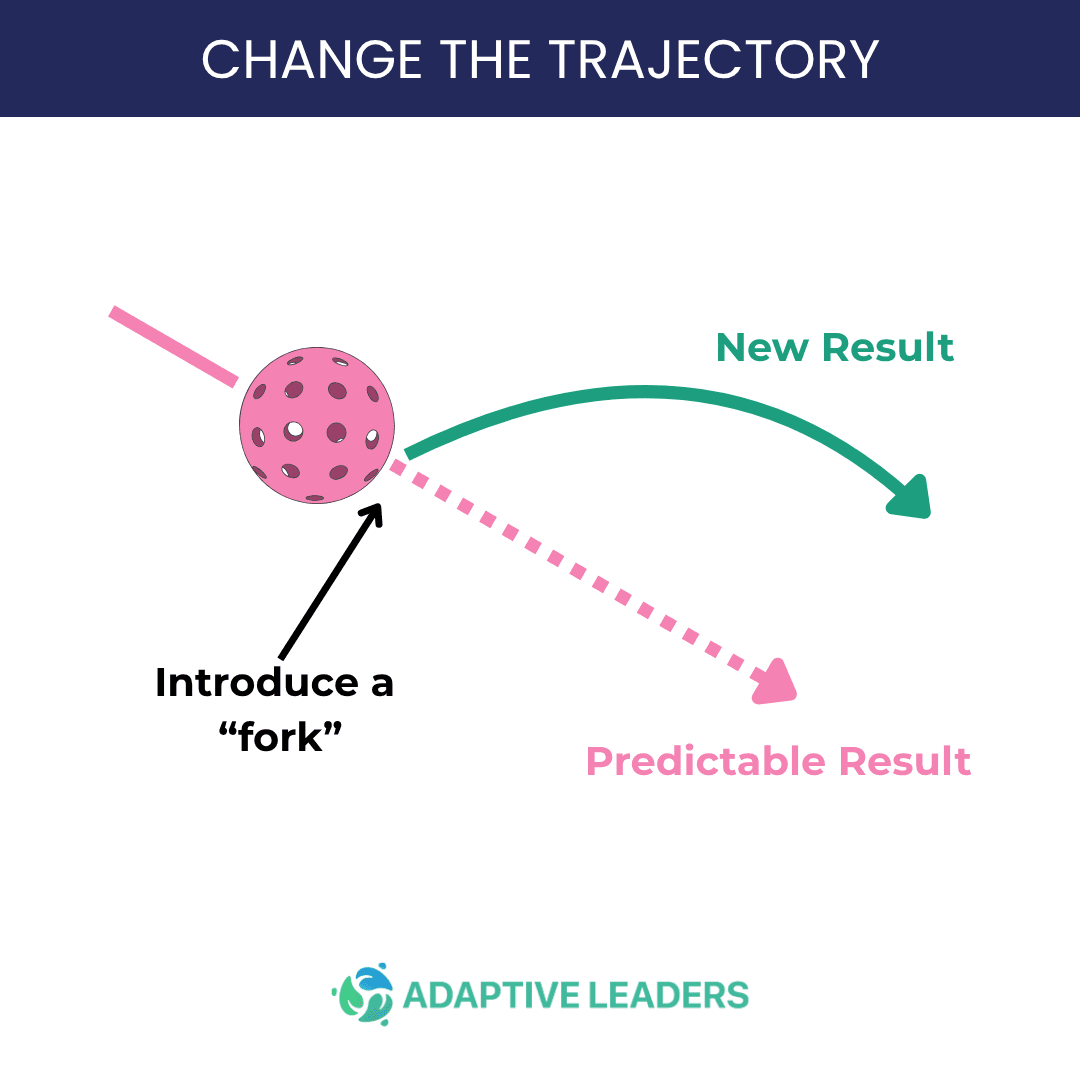
But when a gust of wind blows, “fork” in the narrative has been introduced. There is the predictable (previous) result, and there’s the new (unpredictable) result because even the slightest wind can change where the ball goes.
The first step in changing the trajectory of your interactions with people is to simply recognize and name the current pattern. This will require the 3Cs, but mostly Curiosity.
Pattern Recognition “Curious” Questions:
- The main question: What predictable patterns of interaction are we “stuck” in?
- If I were to script out what’s going to happen, what would the script say? What important unspoken things are happening that wouldn’t show up in the script?
- How might I be contributing to this pattern?
- What’s the best lens to analyze this pattern?
- Speaking: Who speaks first/last/never? Who gets interrupted? etc.
- Deciding: Who has outsized/diminished authority? What is the expected speed of deciding? etc.
- Timing: Who is most/least concerned about time? Who uses more time than predicted? Who isn’t getting enough airtime? Who needs more time to think? etc.
- Moving: Who sits where? Who comes late/early? Who looks where and when? etc.
- Relating: How does the strength/weakness of our relationship affect our interaction? Whose alliances are influencing this interaction? etc.
- What questions are missing from this list?
You can do this work all on your own (and it doesn’t have to take a long time). It can be as simple as thinking to yourself:
- I don’t like how long meetings last. I want to get to a decision quicker.
So how can you break the pattern?
Changing the Trajectory
Again, you don’t have to have a meeting about it. You just need to introduce one simple, safe element that has never been part of your interactions before. You’re not trying to fix everything at once. You’re trying to disrupt where you’re stuck on repeat.
To borrow a quote from a classic movie: “Anything different is good.”
If you try something and the new result isn’t exactly what you’re going for, try something else next time. Make it a mini-game for yourself.
We’re not saying you’re not allowed to discuss these patterns as a team or directly with people. That may be the best approach, depending on the level of trust you have within the team. But it’s not always necessary, especially if you feel it would make the situation worse.
Whatever happened to…
Remember our story about the angry colleague? The pattern our client recognized was:
- I don’t like how my colleague seems to get angry when I deliver certain types of information. Then I have to sit and deal with the aftermath.
So that’s the pattern. Our client decided to disrupt the second part (what happens after the anger), and he used a “physical” strategy: get up and leave the room.
The next day, this colleague got angry exactly as predicted.
Our client told us later, “I stood up and said, ‘I’m going to get a coffee. Do you want anything?’ My co-worker stopped ranting and just stared at me in shock. She said calmly, ‘Um. No thank you.’ When I came back, everything was back on track and we got back to work.”
It’s not magic. It’s a small, disruptive experiment.
The Ball Hog Story
Here’s one final inspirational story from Steve Cuss to illustrate how the 3Cs show up when trying this sort of thing.
Two school basketball players weren’t cooperating because they both thought the other a “ball hog.” They never passed to each other and their team was suffering.
The disruption: one of the players was sick of the pattern, and decided to pass the ball to the other guy 6 times in a row. Pretty soon, the other player was passing the ball as well.
And they didn’t talk it out. It just took one person exercising adaptive leadership and putting a fork in the road where there used to be a pre-determined path.
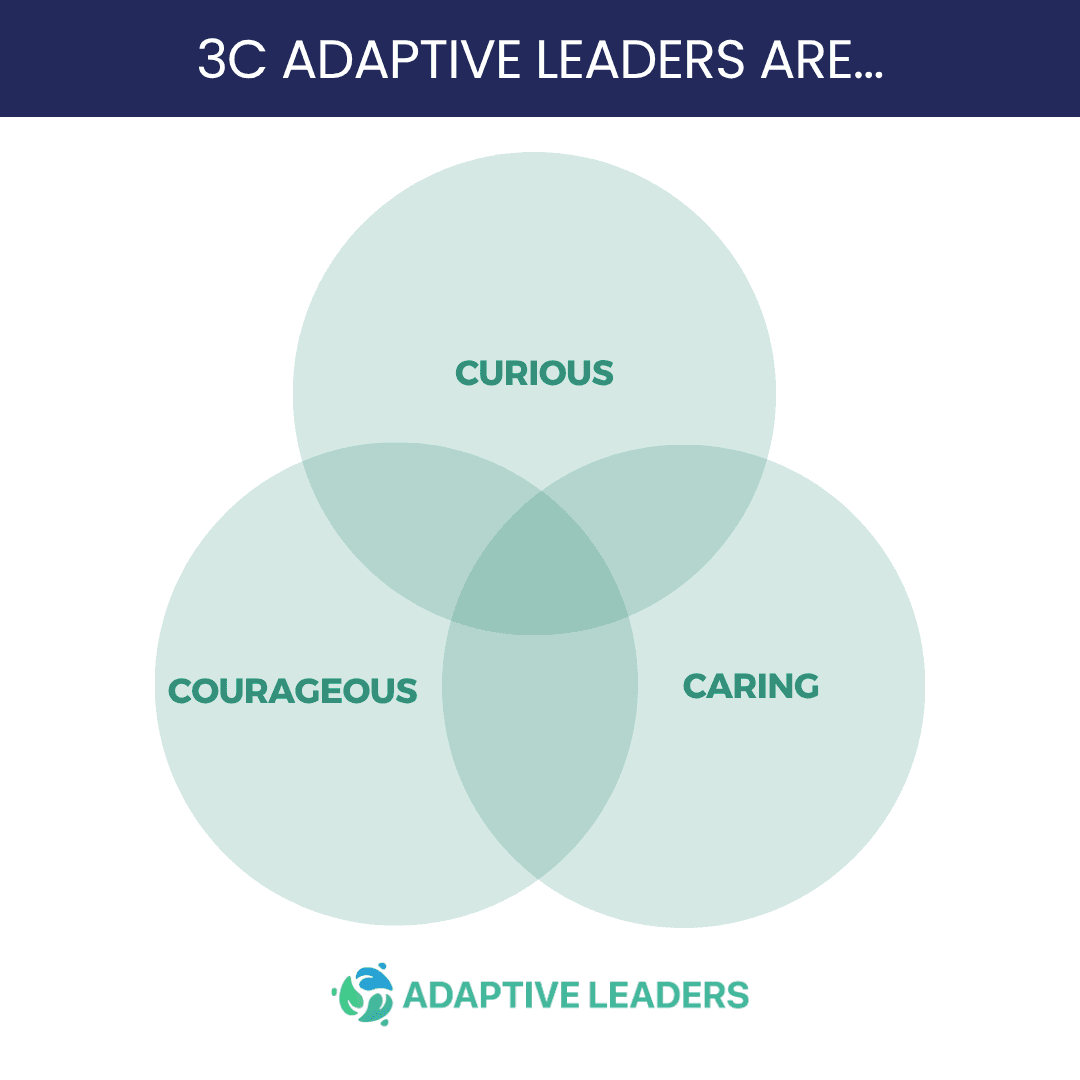
The basketball example shows how all 3Cs need to be activated to change trajectories. Curiosity to ask: “What could I do?” Courage to do the exact opposite of what you’ve been doing (hogging the ball). And Care for the relationships and the greater team’s wellbeing to get out of the pattern.
3Cs and Changing Interaction Trajectories
Here are some questions you can use to change the trajectory of stuck patterns.
Curiosity
- Have I identified the pattern well enough to try something? (see questions above)
- How do I know this is a pattern and not an outlier?
- What assumptions are driving this pattern?
Courage
- What’s one small, new action that would feel slightly uncomfortable but still safe to try?
- What would I do here if I weren’t concerned about how it might be perceived?
- What am I willing to sacrifice in order to break this pattern?
- How many different things am I willing to try before I get discouraged?
Care
- How is it better for me if this pattern gets disrupted?
- How is it better for others?
- How can I act in a way that preserves dignity, even while disrupting the pattern?
The Adaptive Accelerator™
This is the sort of exciting, deep work we do with leaders in our free 1-hour Adaptive Accelerator™ program. If you’d like to make fast and lasting change to flex your adaptivity, join us online or in person near you.
1. Cuss, S. (2019) Managing leadership anxiety: yours and theirs.
Next Steps?
Not quite ready for the whole experience? Try our 3-minute free Adaptive Snapshot for immediate insight and specific advice on your own 3Cs.