
Could it be that you’re frustrated about the very thing you’re not doing yourself?
Recent AI Rollout Challenges
Three times in recent weeks we’ve heard from leaders who are working to integrate AI into their workforce but are meeting resistance. All three are bothered by how much time they spend explaining both how and why to use AI.
“How are we supposed to upskill people if they don’t even agree on the goal?” one leader said.
Our response was the same to all three: “This is not an AI readiness issue. It’s an adaptive challenge.”
So what’s a leader to do?
The AI Adaptive Challenge
One way to define an adaptive challenge is:
- You know what to do, you just… can’t… bring yourself to do it.
This is likely what these teams are feeling. They probably know how to do it by now, but still aren’t.
While there are people on every team who are eager to adopt AI, many feel genuinely threatened by it. The worries include:
- It’s taking my job.
- I’ll be exposed.
- AI is dangerous.
- (and more)
These are real fears. What all three leaders were missing is this: people don’t need you to tell them more things; they need their actual worries addressed. They need you to listen rather than speak.
What worked before (explaining how and why more thoroughly) isn’t working this time. That’s a classic sign of an adaptive challenge: your go-to approach no longer does what it used to. You may be just as stuck as your team is.
The Adaptive Irony
Whenever we’re frustrated that people aren’t adapting quickly enough, we need to pause and look in the mirror. Be careful that the very thing you’re seeing in others isn’t happening with you too.
Here are five ways the adaptive irony shows up:
1. On stubbornness:
- When you say, “People are just so set in their ways,” are you using those same approaches to deal with that?
2. On openness:
- When you think, “I wish they’d just try something before giving a judgment,” are you equally unwilling to try a new approach with them?
3. On urgency:
- When you complain that your team takes forever to get moving on new things, are you moving quickly to give them the clarity and direction they need to actually start?
4. On directness:
- When you think, “If only they’d just tell me what’s really bothering them,” are you creating a space where directness actually feels safe?
5. On feedback:
- When you want people to be more open to feedback, have you recently asked for feedback on your own leadership and genuinely acted on it?
The pattern is the same every time. We hold others to a standard we haven’t applied to ourselves. That’s the adaptive irony.
The 3Cs Break the Cycle
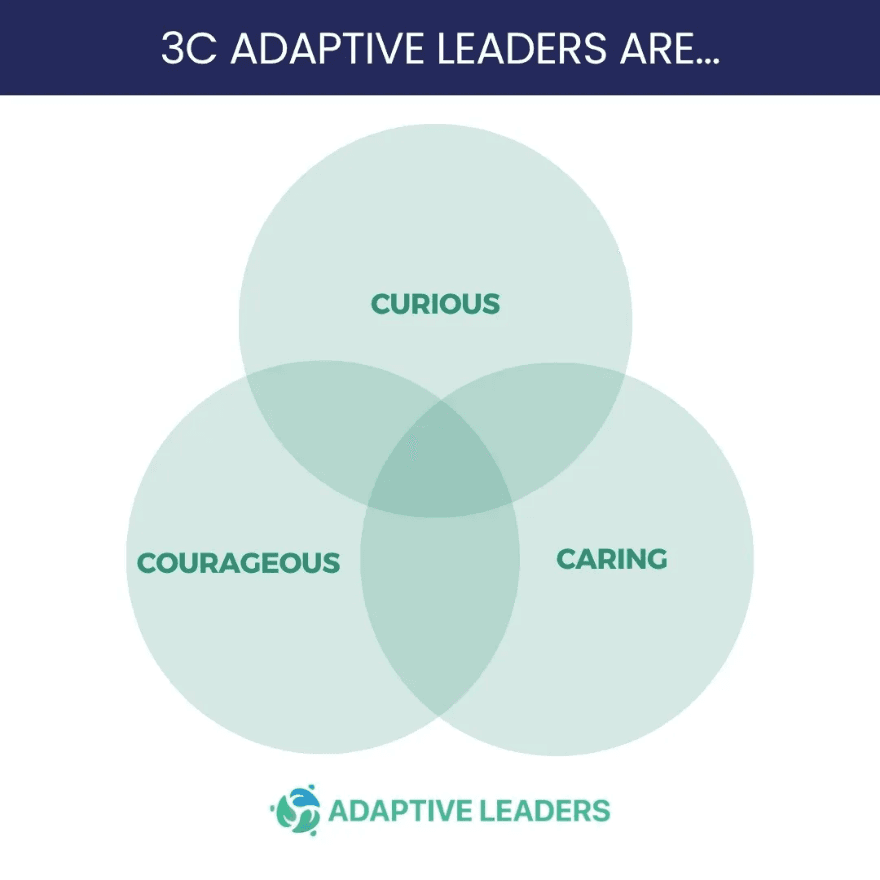
So how do you actually escape the whirlpool of adaptive irony? The same three qualities that help your team adapt are the ones you need to apply to yourself first: Curiosity, Courage, and Care. Let’s apply them specifically to the AI integration problem.
Curiosity
- How can I find out what my team members are actually worried about when integrating AI?
- What does my team really need to be successful with AI?
- What would I learn if I treated their resistance as useful data instead of an obstacle?
Courage
- What am I worried about if AI integration stalls? How might that worry be driving me to old patterns of behavior?
- Who could I ask for advice about this?
- What do I need to admit to my team as we work together on this?
Care
- How can I show that I care about what each individual on my team stands to lose if AI really changes how they work?
- What are the ways I can validate people’s real feelings without compromising the project?
The 3Cs are the way to stay adaptive, which will keep you from doing the same thing you’re frustrated about. By staying Curious, Courageous, and Caring you can be a genuine leader of adaptivity rather than accidentally joining the group who is resisting change.
The Adaptive Leader Studio™
Exploring Curiosity, Courage, and Care is a major part of the exciting, deep work you can scale to your whole organization with our Adaptive Leader Studio. Get started today.