
How intentional is your adaptivity?
Natural Adaptivity
We asked a successful business owner in one of the world’s largest cities, “What’s the secret to your success?”
He was quick to answer: “I have an ability to accurately predict the future, see trends, and adapt to what’s happening.”
He was clearly doing something right because his IT company was growing well in a very competitive market.
But we had to know more. When we asked how he developed this amazing skill he said, “I’ve just always had this uncanny ability to see around corners.”
In other words: it’s a natural talent. And he’s not sure how he developed it or whether others could too.
Many talented people have this problem: they just “get” how to do something, and that makes it hard to sympathize with people who don’t get it. One talented musician played alternating major and minor chords to a friend and said in genuine amazement, “How can you not hear the difference!?” But his friend couldn’t. The genius got it, but the normal guy didn’t.
Defining Adaptivity
At Adaptive Leaders, we believe that adaptivity is the number one game-changer for leaders in the modern workforce. It’s literally in the name of our company. Upgrading your people from “great leaders” to become “adaptive leaders” is what every organization needs to be doing. And we believe it’s something everyone can do, not just the gifted people.
But what is adaptivity, really?
In short,
Adaptivity is deep, lasting, beneficial change.
You need all three parts for it to be true adaptivity in our view.
For example, Leader A needed to balance a bit of humanity with hard-hitting business discussions. So he started asking, “How are you personally?” at the beginning of each one-on-one. Had made a change. He didn’t ask that before. But it wasn’t deep. It was a single question which he patiently waited for his direct reports to answer and then got to the “real” business. He had made a change based on feedback to be more caring, but it was a surface-level change and not an adaptive one.
Leader B knew she needed to stop tinkering with her team’s presentations in such detail. She was able to back off and let them spread their own wings because her boss told her to. But it didn’t last. After a few weeks, when her boss wasn’t really paying attention anymore, she went right back to her hands-on approach. She had adjusted, but it was temporary forced compliance rather than an adaptive change.
Leader C decided that his career path depended on his learning to be more decisive. If he wanted to move up, he needed to show that he could make decisions faster. But the way he went about doing it damaged his internal relationships with his colleagues and he even got complaints from customers. He made a big change, but it actually hurt him rather than benefiting him.
So, we can start to see what adaptivity is not:
- Going through the motions
- Imposed compliance
- Change for the sake of change
- Spontaneous adjustments
We realize we’re diverging somewhat from other views of adaptivity, but this has been our experience with thousands of leaders over more than a decade.
Purposeful Adaptivity
One way to be adaptive is to have spontaneous insight that drives you to make a deep, lasting, and beneficial change to your leadership. Many leaders (perhaps even all!) have stories about eureka moments like this:
- “I realized the way I’d been leading wasn’t going to work anymore. Ever since then, the way I lead is different.”
Those are super valuable and definitely count under our definition of adaptive change. The problem is they are usually not frequent enough for the current pace of work. You need 1 small one of those every week (minimum), and at least a big one every month.
They also depend on a level of “natural talent” similar to our leader in the story above.
So, we want to propose an alternative approach: purposeful adaptivity.
Purposeful adaptivity means you take charge of your adaptive changes through a set of behaviors and perspectives.
And the way to be really proactive with your adaptive changes is to be running on a “3C Adaptive Core.”
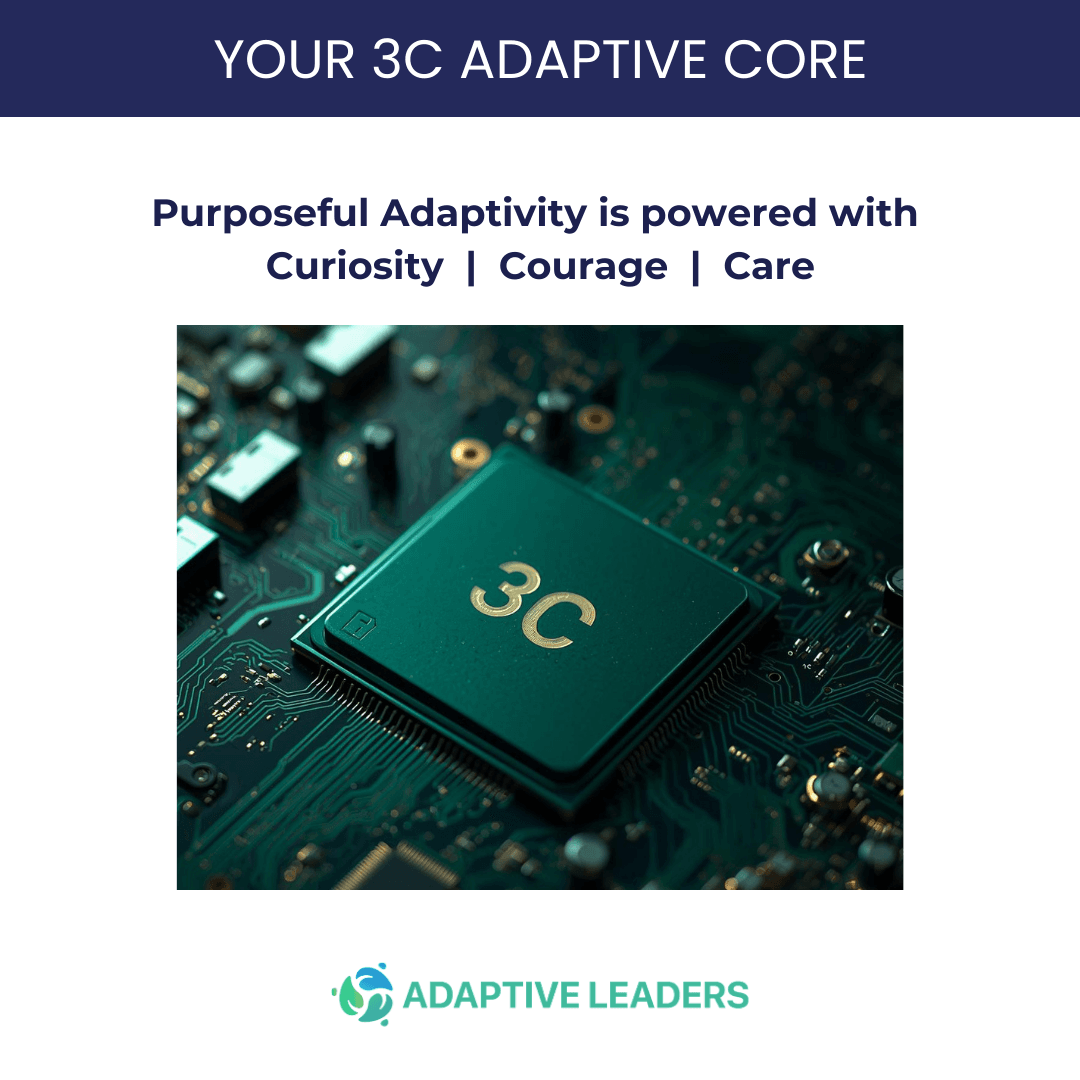
3Cs of Purposeful Adaptivity
Your computer runs on a high-powered processor to keep up with the ever-changing demands you put on it. Leaders need the same sort of engine working to keep them purposefully adaptive.
To power up your own 3C Adaptive Core, ask yourself this simple question:
- Which of the 3Cs (Curiosity, Courage, Care) do I need to activate more than is natural for me right now?
We have asked this question countless times and never had a leader say, “I’m good. I’m at max stats for all 3 of those.”
The 3Cs ebb and flow in seasons, with different relationships, and with different stages of work. That’s why it’s so essential to keep them top of mind.
Here’s what our clients tell us they love about the 3Cs as an adaptive core:
- Easy to remember
- Easy to go as deep as necessary
- Easy to communicate to others
- Not easy to do well / consistently
This is what the business owner in our opening story was doing well. He just didn’t know how to articulate it. He was constantly activating all 3 of these.
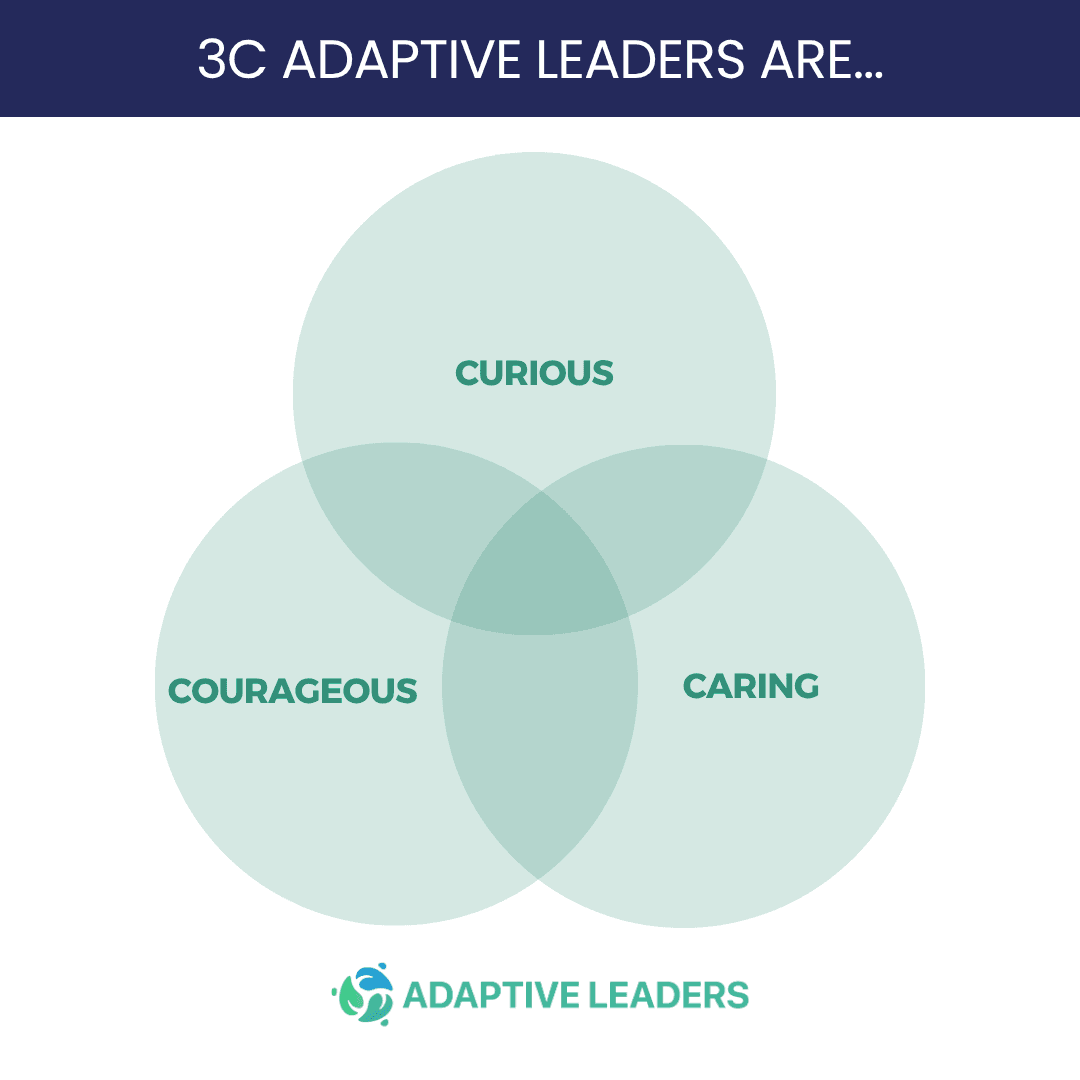
What Leader A really needed to do was find a way to link authentic care with the “real business.” But that took Care about the person beyond results, Curiosity to see how that would affect the relationship and results, and Courage to “sacrifice” time in the meeting.
Leader B needed to discover that her value to the company wasn’t in guaranteeing “perfect” presentations but rather in empowering her team. Courage to stop doing what was most comfortable to her, Curiosity to find where her real contributions could be, and Care for herself to stop doing other people’s work overtime.
Leader C needed to speed up his decision making while keeping the quality of the decisions high. But that took Curiosity to investigate what constituted “good” decisions, Care for the people affected by the decisions, and Courage to ask for really difficult-to-hear but essential input into his decision-making process.
Bonus Tip (Warning?)
The 3C Adaptive Core is your secret to staying purposefully adaptive and making deep, lasting, beneficial changes to the way you lead. But one word of warning: no one said it’s comfortable.
Being purposefully adaptive isn’t deliberately tortuous, but the neuroscientists out there will tell you our brains are wired to avoid exactly this sort of change. Be prepared for a bit of discomfort, disorientation, and maybe even some tears. But doing anything worthwhile has never been easy.
Do the right thing for yourself and your team. Power up your 3C Adaptive Core, even if it generates a little heat.
Next Steps?
Do you know any school leaders? Forward our Adaptive Keynotes for Schools information to them today.
Forward this article to team members (or a friend or family member if you discern that’s a good idea). Also, feel free to take any images from this article and print, share, save, etc.
Finally, if you’d like to talk about an Adaptive Leader Journey for your team, feel free to book a free 20-minute call with one of our coaches to discuss how we can support you in your next big breakthrough.
Looking forward to talking to you soon!