
You got promoted! What could go wrong?
The “Double-Edged Sword”
A leader we’re working with in a transition coaching program, let’s call her Tina, is excited to have been recently promoted to lead a business unit. She has been working there longer than the other leaders in her team, and is also highly qualified, which made her the obvious choice for this role.
However, despite the advantages that got her the job, it became clear right from the start of the transition coaching program that she faces several special difficulties caused by her internal promotion.
“This would actually be a lot easier if someone was coming in fresh,” she said a few times.
For example: everyone knows and likes her. This is good, because they might be positively inclined to support her. But it’s also bad because they like the old her, in her previous role. They don’t necessarily like the new Tina who’s the boss of more stuff now. She may upset people by doing what the role requires, even though an external hire doing the same exact things might trigger less backlash.
The Chinese have a phrase for something that has both pros and cons: it’s a “double-edged sword.” The idea is that a single-edged sword will only cut one way (presumably away from you), so it’s not as dangerous as the double-edged version, which can harm you as much as your opponent.
This is closely linked with adaptivity:
- The very thing that is powerful and helpful in one regard
- Is also the very thing that will kill you if used improperly
The solution is not to get a single-edged sword, but to find those sharp challenges and face them. For an internal promotion, it’s essential that you discover and manage these types of issues as proactively as possible.
These are exactly the sort of deep insights we tackle in our free, 1-hour Adaptive Accelerator.
3Cs and Internal Promotion Traps
If you’ve been recently promoted, you need to fire up your 3C Adaptive Core and discover as many traps as possible right away.
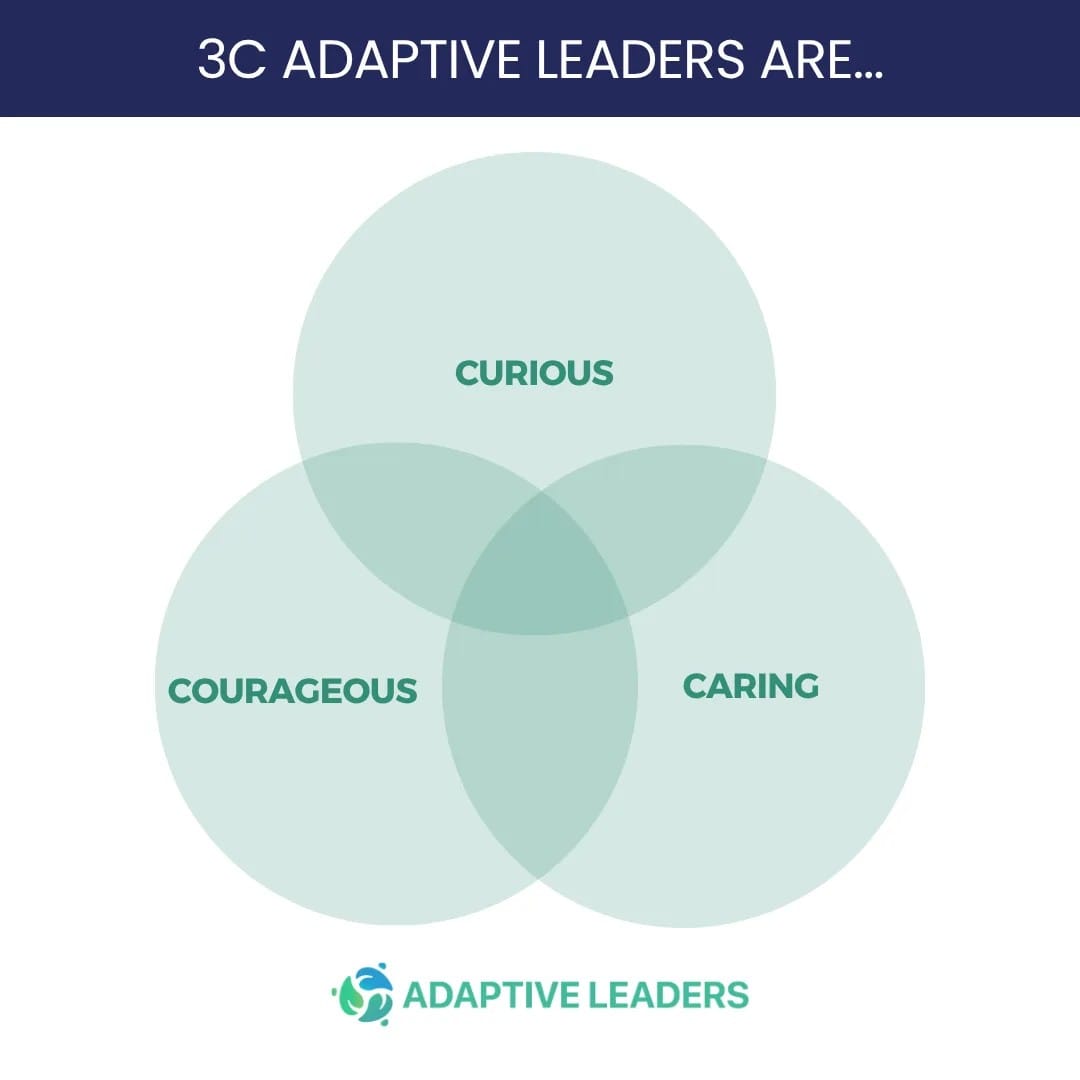
We’d like to suggest there are 3 common internal promotion traps (and the Cs to counteract them):
- Misreading the system you think you already know (requires a new level of Curiosity)
- Avoiding necessary breaks from the past (requires Courage + Care)
- Neglecting self-care (Care)
Let’s look at each one more closely.
Misreading the System You Think You Already Know
The main way to avoid this trap is to crank up your Curiosity to recognize and then test any of these thoughts when they pop up:
- “We’ve worked together before, so we’re already on the same page.”
- “I already know how this _____ works.” (team / procedure / product / customer, etc.)
- “Everyone knows what the expectations are.”
- “They’ll tell me if something’s wrong.”
- “This is basically my same job, just ____.” (bigger / with more responsibility / etc.)
- “They hired me because they know what I’m capable of.”
Those might be true. But how true are they in your new role? You’ll have different visibility into issues from your new vantage point. But others will also view you differently. Someone coming into your role from the outside would be less inclined to make these assumptions.
We especially want to challenge that last one. Don’t forget the old adage “What got you here won’t get you there.” You need to simultaneously not trust what got you here, and not assume you know what you’re capable of. The really exciting result from our work with Performance Leadership is: you might be drastically underestimating the greatness you can achieve!

Avoiding Necessary Breaks from the Past
This trap is tricky because you’ll have to balance the Courage to make bold (and fast) decisions with genuine Care for your people.
Watch out for these mental shortcuts creeping into your thinking:
- “They were my peers yesterday, so I don’t want to come in and shake things up too quickly.”
- “If I raise the bar now, morale will drop.”
- “I inherited this so…” (fill in your ending)
- “I’ll wait for the right moment to make this necessary change.”
- “I can’t hold them accountable because ____” (fill in your own excuse)
- “I don’t want them to think I’ve changed.”
Again, these might be partially true. But they deserve testing.
Let’s double-click on that last one for example. Yes, you need to maintain your values, ethics, and commitments. Those should not change. However, to succeed in this new role, you simply must change. The whole reason for transition coaching is to find the ways you might not naturally change but need to.
Neglecting Self-care
Internal promotions have a special feature almost all the time: you’re doing 2 jobs at once. While external hires will certainly have overlap with their old position and the new one, it won’t be nearly as intense or messy as internal promotions.
You’ll need to take extra Care to avoid running yourself ragged doing both, and recognize these assumptions when they pop up:
- “I can handle both for now.”
- “I don’t need a clear cutoff date for my old job. I’ll just constantly stay available for questions about it.”
- “Taking a break would send the wrong signal right now.”
- “Once ___ happens, I’ll recharge.”
- “I’m used to working hard, this is just what this season requires.”
- “I don’t want to seem like I’m abandoning my old team.”
- “No one else can do what I was doing, so I’ll keep covering it until they figure it out.”
While those might be true, it’s worth testing these assumptions. For example, another leader we did transition coaching for proactively asked to hand off some of his current work ahead of the official “start date” for his new role, to free up time for his transition process. This took all 3 Cs, and tested that final assumption in the interest of self-care.
If done right, transition coaching can help you avoid all 3 of these internal promotion traps and you can discover other traps that are unique to your situation. Don’t make the mistake of assuming internal transitions are “easier,” just because the leader is a known quantity.
Next Steps?
Our coaches are certified by our partners at Genesis Advisors to offer best-in-class transition coaching to you and your team. Get in touch today to learn more about which transition coaching program makes sense for you or someone on your team.
Don’t want to talk to anyone? Try our 3-minute free Adaptive Snapshot for immediate insight and specific advice on your own 3Cs.