How does your team react when you unexpectedly cannot show up?
Our book, Performance Leadership, answers a single question: What can you (the leader) do to move your teams to a higher level of performance? “Performance,” in this case, generally refers to the amount of meaningful work teams produce toward the most important business goals.
But there’s a twist on the word “performance” that can add an extra dimension to this topic. Let’s talk about an actual musical performance for a moment.
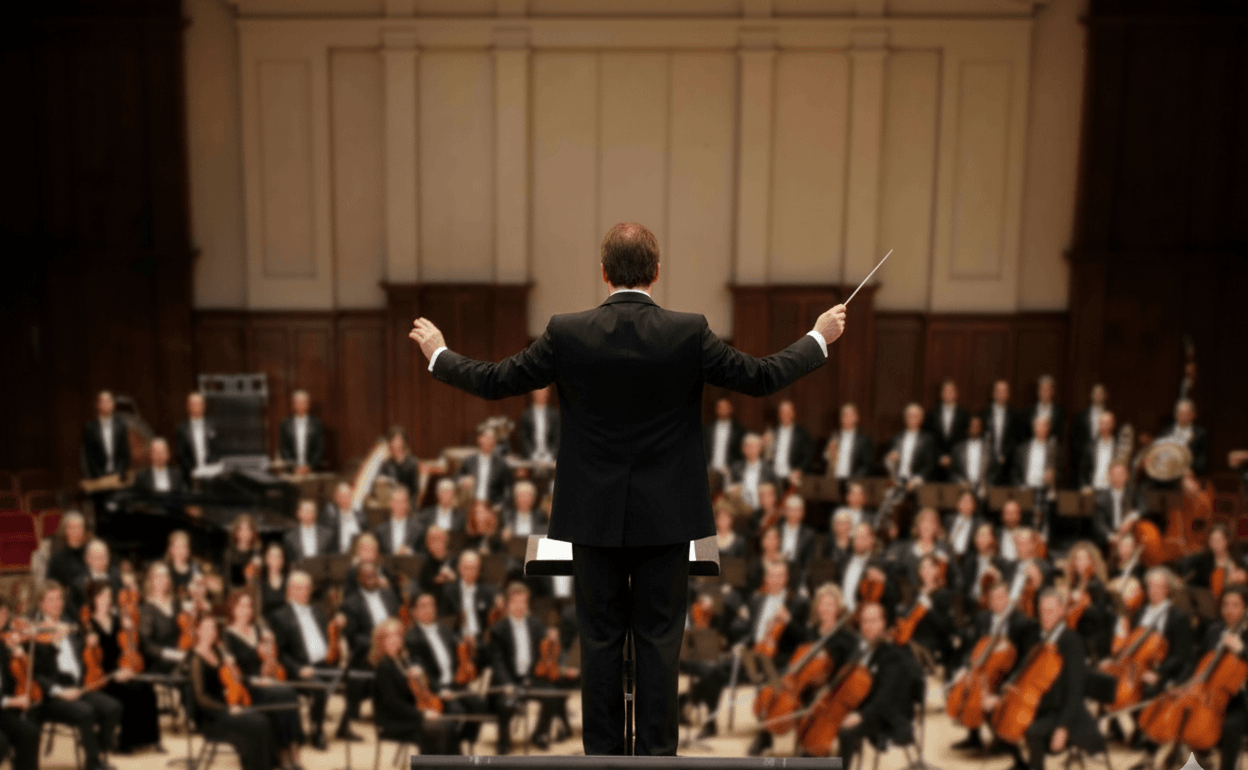
Is the Conductor Necessary?
Several of our coaches have formal music training, a few specifically in conducting ensembles (choir and instrumental). One of the most frequently asked questions from non-musicians who see a conductor is:
- “Do the musicians REALLY need that person standing there waving their arms?”
It’s a valid question. One of our coaches remembers watching a performance of Peter and the Wolf as a child and thinking, “Although I couldn’t play any of those instruments, I could do that guy’s job!” (referring to the conductor).
So, we asked our more musical coaches directly and here’s their answer to how important a conductor is for the performance:
- The higher level the musicians, the less necessary the conductor is at the performance.
Ah ha! So, they admit that, the conductor often isn’t strictly “necessary” for an ensemble to perform. There are even “Conductorless orchestras” which deliberately plan to perform without one, such as one student orchestra that played without a conductor because they knew there was a high likelihood she’d be out having a baby (which she was).
Doesn’t it seem odd that, at a glance, the highest-paid orchestra position seems to be non-essential?
Story
We work with many excellent leaders, and they often have outstanding teams. Some are arguably the best in their industries.
One senior leader described an excellent manager in his team this way:
“When she’s not here, we don’t even notice because she has setup her team so effectively. They know exactly what to do and are highly empowered to do it.”
He meant this as a compliment, which it truly is. But on the other hand, she would be justified in thinking: “What’s next for me? If my team is already performing at such a high level, and can even do so when I’m not there, do they really need me?”
See how that starts to sound like the question about the orchestra conductor? Leaders themselves sometimes find themselves facing the question: “What am I really doing here?”
Let’s answer the question from the musical perspective and see what we can cross-over to apply to leadership.
Mostly Behind the Scenes
Our coaches said the conductor isn’t as necessary for high-level musicians? So that’s one way to answer the question: the higher performing the team members, probably the less guidance or input they need from the leader.
But notice our coaches also said, “at the performance.” Most of the work in an ensemble happens outside the performance, specifically: in the rehearsals. That’s where the conductor really earns the big bucks.
Yes, the notes are written on the page. Yes, everyone knows their instruments and can play their parts (although not necessarily!), but the big difference between a solo concert and an ensemble is: the musicians are creating musical art that is impossible for any one of them to do alone. That means disagreements are bound to occur with how exactly to get from the beginning of the piece to the end.
A few leadership parallels immediately present themselves: how can your team of highly talented professionals create something bigger than the sum of their skills? If you just want a group of people working individually in a shared office space, that’s not too hard, and the leader may not be necessary.
The challenge comes when talented people have to coordinate and resolve disputes. A direction must be agreed upon. The more talented the people the harder this might be. The person who facilitates the resolution of these disagreements behind the scenes in an orchestra is the conductor. In a team, it’s usually the leader.
Handling Emergencies
Orchestral performances that have sold tickets are sometimes forced to bring in an emergency conductor at the last minute, often with time for only one rehearsal or none at all.
Lenard Bernstein (arguably one of the greatest conductors of the last century) got his first high-profile conducting appearance in 1943 because the New York Philharmonic’s regular conductor was too ill to appear. Bernstein didn’t even have a chance to rehearse with the orchestra, yet the show was a huge success.
Even when conductors do show up, they might have to handle other emergencies like an important soloist who can’t appear.
In 2019, when an important soloist for the Orchestre symphonique de Montréal suddenly fell ill just before showtime, there was no time to rehearse a replacement piece. Conductor Karina Canellakis solved the problem. She successfully conducted the orchestra playing a different piece (that didn’t require a soloist) for the first time in front of an audience of 2,000 people. Even the best musicians would have trouble pulling that off without someone “waving their arms” to guide them.
In leadership there are always unforeseen situations that arise (usually at the least convenient time!). Someone has to take responsibility because “the show must go on.” In music, that person is the conductor. In an organization it is the leader.
Performing Well vs. Surpassing Yourself
We’ve talked about how an orchestra can function without a conductor for a performance (but not a rehearsal) and how conductors play an essential role in firefighting when emergencies occur. There’s still one more angle that’s perhaps least obvious but most important of them all.
The conductor must inspire greatness in the group.
There are conductors who instill fear in their players to push them to excellence (for example, Toscanini). But another approach is beautifully described by the renowned Hungarian conductor Antal Doráti. He says the role of the conductor is “to make an orchestra wish to play well, because, if it so wishes, it will do so. What a conductor must be able to do is to interest and involve an orchestra” (Dorati, A., 1981. Notes of seven decades).
Using modern leadership language, a conductor is primarily concerned with motivating high engagement, synergy, and collaborative breakthroughs.
The cross-over lessons for leadership readily leap to mind with no elaboration!
But keep in mind one other fact: The conductor is the only person in the orchestra not making a sound. On the one hand, that appears to make him the most dispensable and “least important,” but that’s only if you focus on the nuts and bolts of producing musical notes. On the other hand, he is the most essential because no one is doing what the conductor is doing: focusing on the group.
The greatest compliment Dorati ever received he actually overheard from one musician talking to another walking out of one of their concerts. The musician was so proud of the performance he told his colleague: “I am ashamed of myself that I did not always play like this.”
Now that’s deep inspiration paired with musical breakthroughs!
Performance Leadership Connection
The core of our EMMA model is actually the second letter:
- Expectations
- Motivation
- Measurements
- Accountability
You need all 4 parts in place to guide your team to greater performance (both in business and in an orchestra), but the real sweet spot is when your whole team is motivated to go beyond what they’ve ever done before.
That’s when even the highest performing teams in their industries see breakthroughs they didn’t know were possible.
That’s what the leader should be pursuing.
Next Steps
Where do you need to make less sound, play your own instrument less, and focus more on motivating your team?
One place to start could be our free Work Motivations Profile. Try it out for yourself first. Then give it to your whole “orchestra.”
You’ll be amazed at how quickly you can tune inspiration and motivation!
Please also feel free to book a free 20-minute call with one of our coaches to discuss how we can bring inspire you or your team to greatness.
Looking forward to talking to you soon!