How do you know if your team is making progress?
Story
A CEO looked across the table at our coach.
“I know what it is. You asked me to pick the one, most important thing to measure that will make all the difference. I’ve got it.”
“What is it?”
“Quality of delivery,” he said confidently. “Nothing else matters as much as that for our business. If we can improve that, everything else will follow.”
“Great! And what is the current quality?”
“We’re not measuring it quite right currently. We need to figure that out ASAP.”
KPIs vs. Drivers
The interesting thing about “Measurements” is: it makes the most intuitive sense of all the 4 aspects of our Performance Leadership framework (EMMA):
- Expectations
- Motivation
- Measurements
- Accountability
Leaders in business, education, and non-profits know they must measure things to figure out if they’re “winning” at accomplishing their most important goals.
The problem comes not with knowing that we should measure, but knowing what to focus on (and what to ignore).
There are two basic questions that leaders need to think through:
- What is the most important KPI to measure? (Ideally, 1 or 2 tops for the team)
- What are the Drivers (things we can do) that will have the biggest effect on that most important thing? (Ideally only 1 thing each person does on for each area of focus)
In our story above, the CEO decided that quality of delivery for their product was the answer to question 1.
But his trouble came at question 2: he wasn’t sure which actions (aka Drivers) would raise the quality of delivery the most, because he wasn’t even sure how to quantify the current quality.
You have to know the current score before you can start improving it.
Ultimate Frisbee Example
One of our coaches plays ultimate frisbee regularly, usually on a random team with people who haven’t played together often. But he has discovered one amazing thing: he can often win, even with a team of players less skilled than the opposing team, by giving them some on-the-job coaching.
- What’s the most important thing to measure to win at ultimate frisbee?
Points on the scoreboard.
That’s an easy one. There’s only one definition of winning according to the official rules.
- What is the most important Driver (the thing players can focus on and actually do) that will win more points?
Passing backward.
He noticed that experienced soccer players who played ultimate frisbee for the first time were doing something other players weren’t: they were willing to pass backwards to the person who had just passed to them. And their team often ended up winning.
This is highly counterintuitive to new players because moving “forward” is the way you win points. But what our coach experimented with was: “If I tell all my players, to always look backward” or “Your best pass is usually backward” will we win more points?
Indeed, yes.
The main enemy of moving forward is not moving backward, it’s turnovers. And turnovers happen more frequently (for new players) when they’re trying to do something heroic (like passing forward, especially big throws). By focusing on passing backward, it reduces the number of turnovers and improves the score.
But they don’t need to think about all that! They just need to focus on one thing: “My job is to pass backward as much as possible.”
One KPI (the score) influenced by one Driver (passing backward) made for a Measurements game that people could win.
And here’s the key: our coach praised every backward pass, even if it was incomplete. By doing so, he was reinforcing that’s the correct Driver to focus on.
But in My Company…
We know, we know! It’s a nice story but it’s not that simple in your company.
That’s where the 3Cs come in (again).
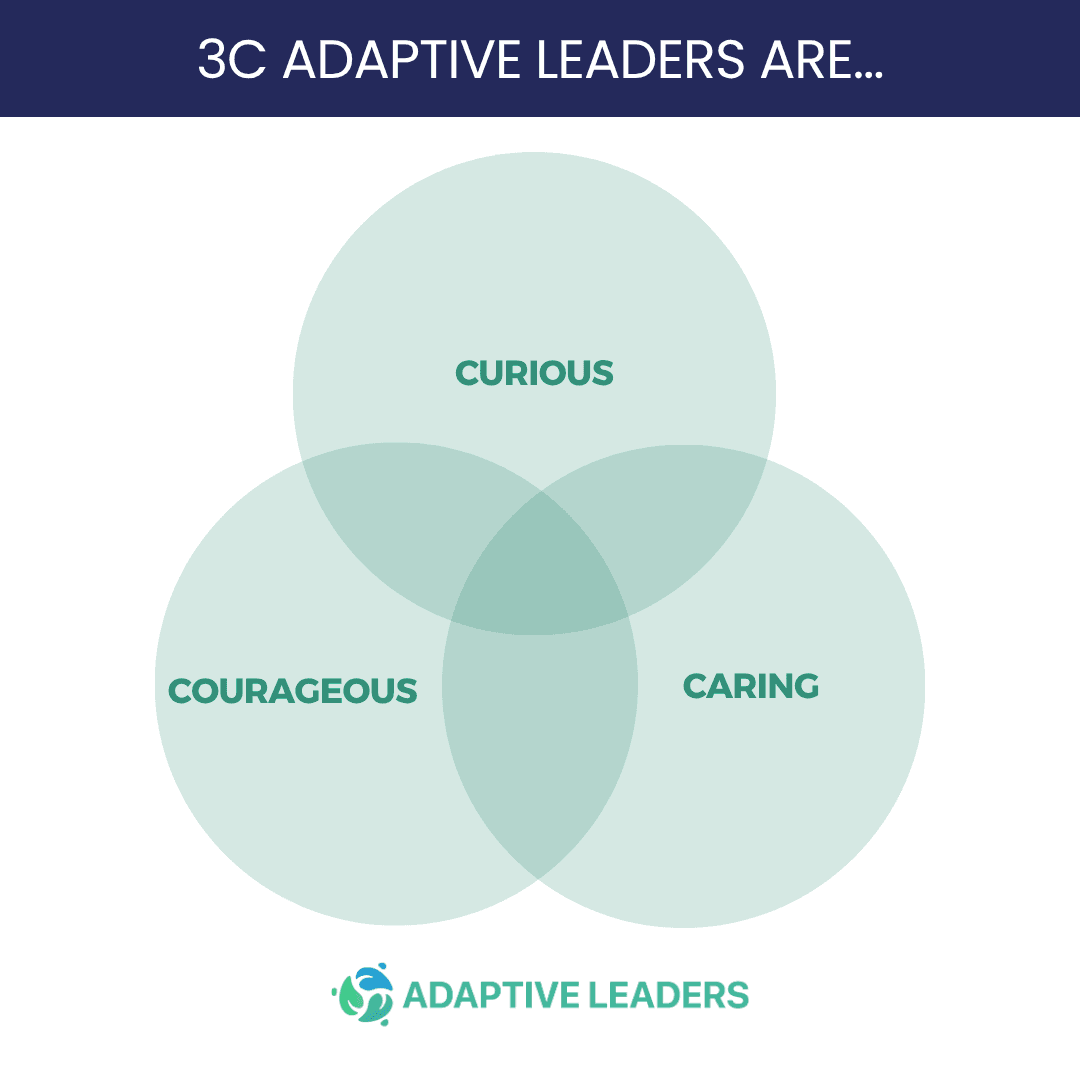
What would it take to “refresh” the way you do Measurements in your company? You’ll most likely need to engage Curiosity, Courage, and Care differently than you have so far.
One simple step is to ask your team 2 questions:
- “What are we not measuring that we should?”
- “What are we measuring that we shouldn’t be?”
Can you see how all 3Cs are firing within those two simple questions? In our Adaptive Leader Journey™ we do an in-depth look at Measurements from a 3C perspective, and the answers people come up with are fascinating.
In the meantime, you might work through those and a few additional questions as you activate the 3Cs around Measurements.
Curiosity
- What crucial data are we missing as an organization? As a team?
- What crucial data am I personally missing?
- How do we know what Drivers are really affecting the “winning” score?
- What do we need to do to confirm our Measurements?
Courage
- Where are we wasting time/energy/attention with our Measurements?
- What uncomfortable steps would be required to really Measure the right things and nothing else?
- What would be the worst thing about Measuring the right things?
- Who will be unhappy if we change the way we Measure, even if it’s the right thing for the organization?
Care
- How can I enhance the working lives of my team members who are most motivated by Measurements?
- What about those who are allergic to Measurements?
- How might an open discussion about Measurements demonstrate Care to my team?
- What do I need to get better at Measuring to make space for the self-care I need?
Let’s talk about that last one a little more in-depth.
One Final Example: Time Spend
Leaders often feel guilty they’re not spending enough time on something. In fact, we work through a “time spend” worksheet with them in our Adaptive Leader Journey™. But there’s often a missing piece, which is to ask:
- What’s the real data for your time spend?
For example, many leaders we’ve worked with over the years have some version of this assumption:
“If I [make this adaptive change I know I need to make], that will waste a lot of time. Which I don’t have!”
So, the question again is:
- How much time?
All 3Cs are required to answer that:
- You have to be Curious to know the real numbers.
- You have to be Courageous to try doing a little bit of what you’re afraid will waste time.
- You have to be Caring toward yourself and your team so as not to break anything important while you run your test.
Leaders are often surprised by the real numbers.
On a journey to become more adaptive, surprises are good!
Next Steps?
Forward this article to team members (or a supervisor if you discern that’s a good idea).
Also, feel free to take any images from this article and print, share, save, etc.
Finally, if you’d like to talk about an Adaptive Leader Journey for your team where we do a deep dive into EMMA and the 3Cs to integrate them into daily practice, feel free to book a free 20-minute call with one of our coaches to discuss how we can support you at making your next big breakthrough.
Looking forward to talking to you soon!