
What’s the last thing your team stopped doing?
“It’s already too much”
At a senior leadership team meeting we were facilitating, the team identified many important directions for them to focus on, improve, and forge new ground.
Then someone said, “The problem is, we’ve already got so many initiatives going, where will we fit these in? It’s already too much.”
Quiet nods acknowledged the very real truth that had been spoken like a beacon of light into the darkness.
“But what can we cut?” someone asked.
Again, silence and thinking.
“I don’t know,” someone else said. “But I can guarantee that everyone who works for us is feeling the same way, maybe even more.”
That’s what finally did it. They decided they’re going to have to ruthlessly cut something.
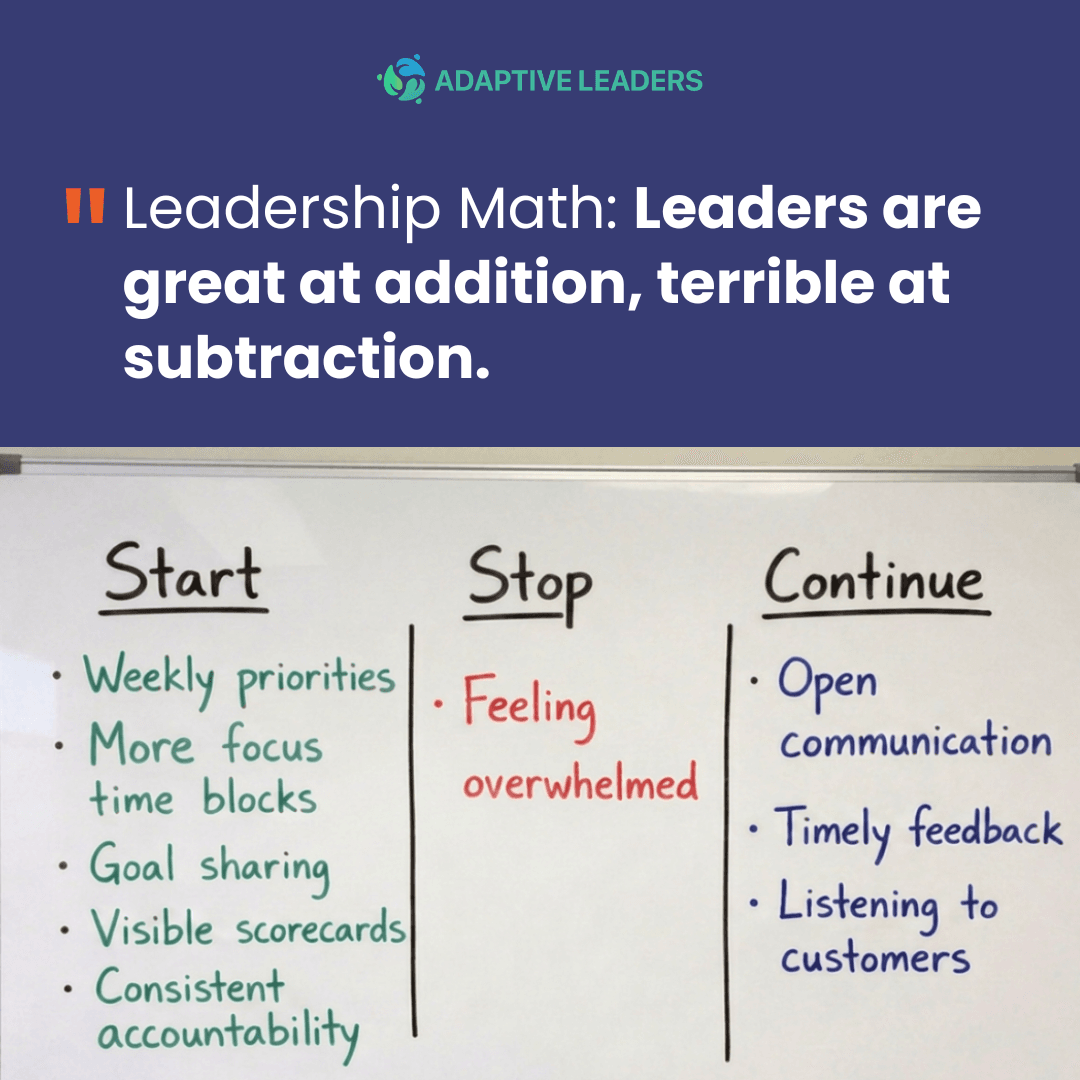
Leadership Math
We call this the golden rule of “Leadership Math”
- Leaders are great at adding, terrible at subtracting.
When we put this idea out there, people often go through a variety of reactions:
“Yes! That’s what’s wrong with my boss!”
or
“Ouch. That’s true of me.”
or
“Let me add that to my notes.”
Whatever your reaction, know that you’re not alone in struggling to stop doing things. We appear to be wired to add more easily than subtract.
Addition Bias
In 2021, researchers at the University of Virginia published research showing people tend to “overlook or undervalue subtraction as a way to improve objects, ideas or situations” (Adams, Converse, Hales & Klotz, 2021). Leidy Klotz went on to publish Subtract to further develop the principle.
One of our favorite examples of the rare innovation by subtraction is the type of balance bike kids learn on nowadays. Anyone growing up 20+ years ago may have learned by adding training wheels (resulting in a bike that was bigger and heavier and not super similar to the real skill of riding a bike). But then came a subtractive innovation: let’s take away something from normal bikes: the pedals! It’s magical how quickly children can learn to ride a normal bike by practicing on these strider bikes first.
When it comes to leadership, it is especially important to recognize your own addition bias. It doesn’t just affect your work and wellbeing, but it always trickles down to the teams you lead.
Solution
One very practical solution is to make a rule (we suggest even writing it down somewhere):
- If we add something, we take something away.
Our role clarity worksheet guides you to do exactly that by forcing adjusted percentages to always total 100%.
Another way to do it is by deleting an initiative/project/strategy. How amazing would it be for your team to hear you say, “I know we’ve invested time and energy into X, but right now Y is more important so I want everyone to completely stop working on X until further notice.” It might blow their minds.
We said this is practical, not that it’s easy. You will certainly meet resistance either in your own head or from the mouths of others if you try to cut something important enough to matter.
The 3Cs and Leadership Math
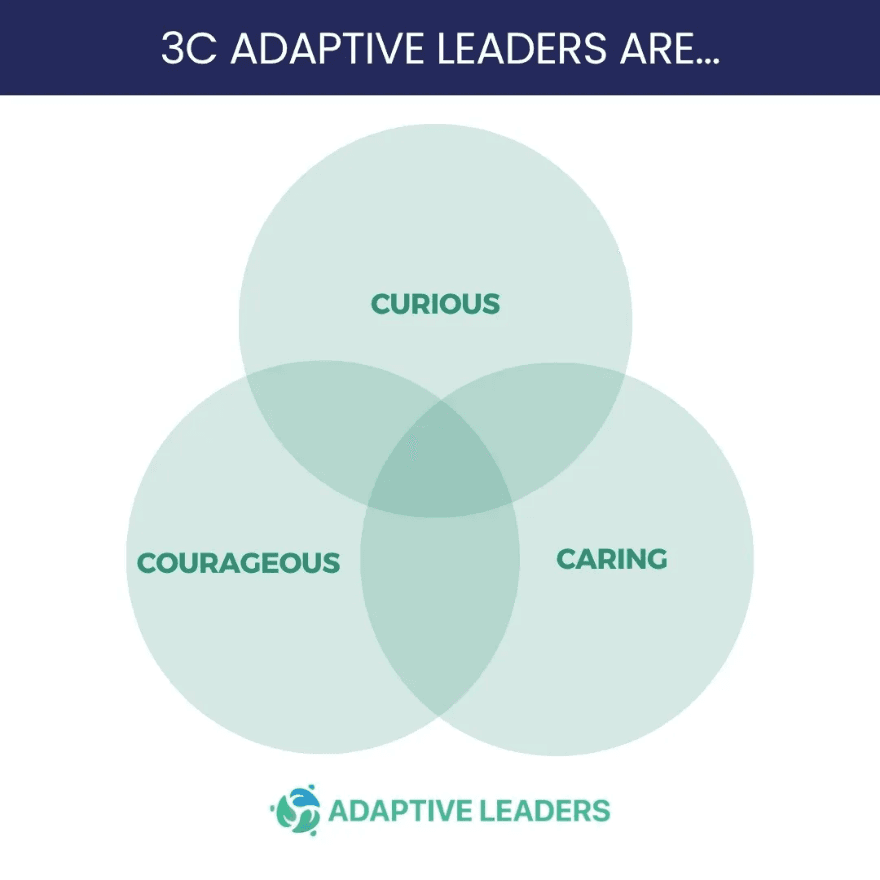
The 3Cs are the solution to your “Leadership Math” problem. The addition bias is often driven by worry: It feels safer and socially acceptable to do more, work harder, and set bigger goals. Only with Curiosity, Courage, and Care can you break the default human tendency to pile more on yourself and your teams.
Curiosity
- What are we currently spending time or attention on that we should stop completely?
- How can we know what the most important thing is for our team right now?
- Who on my team would tell me the truth about what isn’t working, if I asked them directly?
- Where have we been adding and we need to just stop?
Courage
- What are we holding onto because removing it feels like a bigger hassle?
- What’s the biggest fear I have about cutting something?
- What would I risk by stopping that thing I know I should stop?
Care
- Where is a process/meeting/initiative costing my team more than it’s worth?
- Who is carrying too much?
- Where is my calendar too full of things and not full enough of relationships? Where is the opposite true?
You can be the leader who breaks the Leadership Math pattern. You can use the 3Cs to show the adaptive power of subtraction for yourself and your team.
Adaptive Leader Studio™
This is exactly the sort of exciting, deep work we do with leaders in our Adaptive Leader Studio™. If you’d like to make a fast and lasting change to flex your adaptivity, join us today.