When was the last time you were in awe?
A Group Pause
Typically our stories feature clients, but this week we’re sharing what happened at our last Adaptive Leaders team meeting.
Beth asked everyone, “When was the last time you felt awe and what did that do to you?”
Although it may feel like an icebreaker, everyone went deep. We heard mini stories about swimming with dolphins, admiring blue skies, miraculous healing of family members, and even watching a 5-year-old son master a flight simulator.
What did it do to us?
We shared how it made us feel connected to a bigger world. Some felt they had underappreciated or underestimated people. Some expressed thankfulness to each other for sticking together.
Beth explained pausing to feel awe (and share about it later) is more than a fun team-building activity: it builds necessary leadership skills.
The Science of Awe
Dacher Keltner (quoted in a recent TIME article) has spent more than two decades at UC Berkeley studying one emotion most leadership research ignores: awe. His book, “Awe: The New Science of Everyday Wonder and How It Can Transform Your Life,” pulls together that research into a simple definition.
Awe is what you feel when you encounter something so vast it doesn’t fit your current understanding of the world, and your mind has to stretch to make room for it.
Awe predicted greater generosity in an economic game. Induced awe increased ethical decision-making and prosocial values. In one experiment, participants who simply stood among a grove of towering trees for one minute became more helpful and less entitled than a control group, an effect the researchers traced directly to feelings of a smaller, more proportionate self.
For leaders, this is the counterintuitive part: getting smaller, proactively, is what makes room for better judgment and more generous decisions.
Putting Awe to Work: The 3Cs
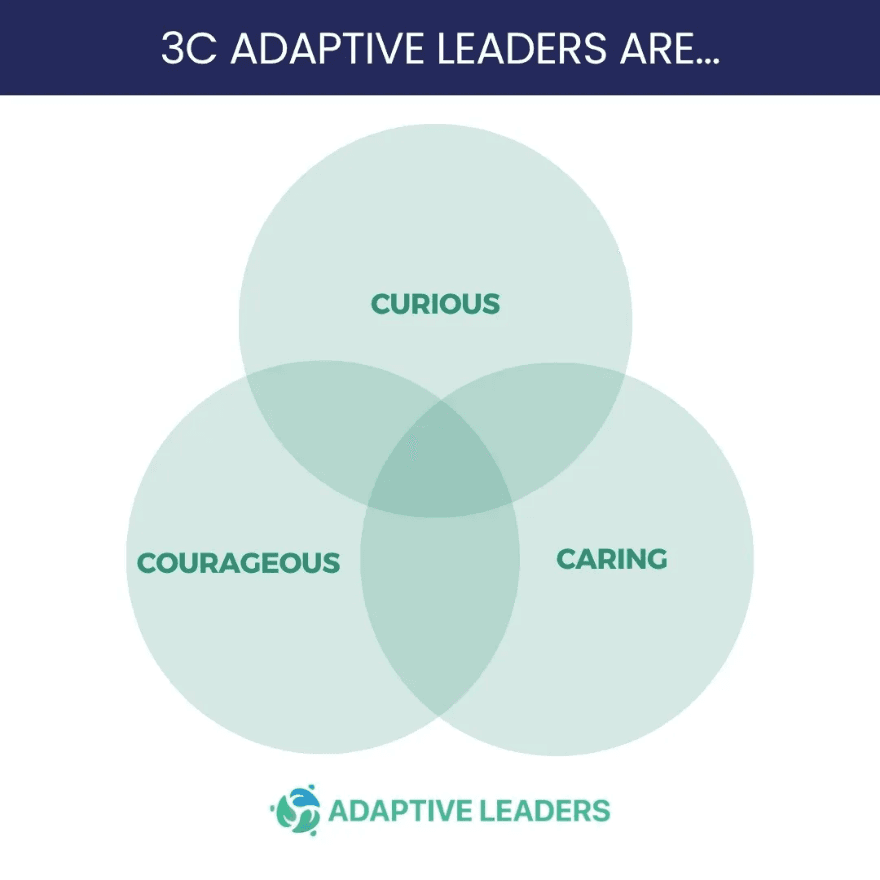
Curiosity, Courage, and Care are the core of becoming more adaptive in your leadership practice. Practicing awe and sharing it with your team can help strengthen all three.
Curiosity
- What in today’s meetings, walks, or conversations am I rushing past that deserves a second look?
- Where on my team is someone doing something spectacular that I haven’t stopped to notice?
- How might I build one minute of undistracted attention into my daily routine (no phone, no multitasking)?
Courage
- What would I risk losing if I wanted to protect sixty seconds of my day for awe?
- How do I model wonder and attention for a team that equates busyness with value?
- Who on my team needs to see me pause before they’ll believe it’s “allowed”?
Care
- How does my team’s collective stress load shift when we build in small, shared moments of wonder, a walk, a story, a pause?
- What would it look like to name beauty on my team out loud, in the room, this week?
- How might lowering my own reactivity change how safe my team feels?
By normalizing and embedding pausing for wonderment into your personal and team practice, you’re improving adaptivity at a micro-scale that will compound over time. Don’t believe us? Try it for five days in a row and see what happens inside and around you.
The Adaptive Leader Studio™
Exploring Curiosity, Courage, and Care is a major part of the exciting, deep work you can scale to your whole organization with our Adaptive Leader Studio. Get started today.