Have you ever dreaded something so long that your feelings now cost more than the task itself?
The Fear Factory
Norm O’Hara leads the factory in southern China that makes Springfree Trampoline. Eight years ago, he almost quit.
“It was messy. It was chaotic,” he says. There were backlogs, defects, and safety issues. Norm also had no manufacturing background.
“I truly had no idea how to do anything with manufacturing. I was completely unfit for the job. I had no experience in it.”
The invisible problems weighed on him even more. “What you couldn’t see was the stress that I was feeling, the fear that we were going to ship defects or something wrong, the frustration,” he says. “I was embarrassed if someone came to see the factory.”
He felt defeated and dreaded going to work.
What’s On Your Dread List?
Hopefully, you don’t dread your job like Norm, but you probably have at least one task on your “dread list” or as some people call it “the drudgery list.”
It could be a message you should send. Paperwork to finalize. A conversation you need to have. Or something you need to create.
Here’s how we define the dreaded task:
- Something important that keeps getting put off and that you’re really not looking forward to doing
A friend of ours applied for his foreign wife to get a visa to visit his home country, but because of their complex international situation the documentation required was overwhelming (spoiler: it ended up being 270 pages). He called it an “intimidating Pandora’s box.” He hated even thinking about taking the next step.
Most people don’t need much help to identify what’s on this list, but making progress on it can seem impossible.
Compounding Guilt
Part of what makes the dread greater can be a sense of guilt and the voice in our heads saying things like:
- “I should have done this already.”
- “Someone different in my shoes wouldn’t have this problem.”
- “There must be something wrong with me.”
- “I can’t admit I’m dreading this.”
Although we never want to excuse you from doing something you should do, we do want to affirm that this is part of being a normal human (if you don’t mind considering yourself to be one).
Research suggests that guilt and inaction can be a vicious cycle where you start feeling bad that you didn’t do something, continue to not do it, and then feel worse (Sirois and Pychyl, 2013). The word “procrastination” doesn’t help because it just feels so immature. You might feel better using the term “inaction inertia” (Tykocinski and Pittman, 1998).
Strategy 1: Study the Inaction
At Adaptive Leaders, we see even these negative feelings and “inertia” as clues you can learn from. You probably have an assumption holding you in place, something like:
- “I’ve already put this off so long, if I tackle it now I’ll feel even worse.”
Or
- “If not doing it makes me feel this bad, then doing it will certainly be worse.”
Or
- “If I admit I’m dreading this, then people around me will think less of me. It’s better to just say I haven’t gotten around to it yet.”
The 3Cs (more on this below) can help you untangle and understand your dread in a way that can pay dividends later.
For one of our coaches, her struggles often have to do with appearing “irresponsible.” Anything that falls into that general domain gets cranked up to Dread Level 11. But identifying that pattern and her underlying value of being responsible has become a powerful tool in her hands.
This first strategy is about becoming a non-judgmental student of your own dread. Without adding to the guilt, try to understand what’s behind it.
Strategy 2: Bite-Sized Chunks
Norm said he’s trying to just shave “two seconds” off a process. That’s a really bite-sized chunk, but it takes a lot more than two seconds to do it. This strategy is about right-sizing a part of the dread.
Don’t think you have to do all of it at once.
Our friend with the huge visa application said his goal was to break it into “embarrassing small” steps. For example, that reference letter that he needed to get felt huge. Step 1 was “choose someone to ask to write the letter.” That was it for the whole day. The next day might be something like “write the message to ask that person.” And the following day: “send the message to ask that person.”
He told us that “paradoxically, committing to do less really got things moving forward.”
Strategy 3: Crowd Source
It’s easier said than done (because of the guilt and regret), but getting other people involved can be a total game-changer.
Norm says he wants everyone to speak up when they identify: struggle, frustration, burden.
“We don’t want any of those,” he says. “Who wants to describe their job with those words, right? So we want to just get those out of their way as much as possible to free them up to be more successful.”
The great thing about those 3 words is that they’re putting the blame on the task, which should be safer than just saying “I’m the problem because I’m procrastinating.”
Getting other people working with you is one of the best ways to disrupt inertia.
Listen to the whole conversation with Norm on Episode 13 of The Adaptive Journey wherever you get your podcasts.
The 3Cs and the Dread List
Your team can support each other by employing the 3Cs of adaptive leadership as a group.
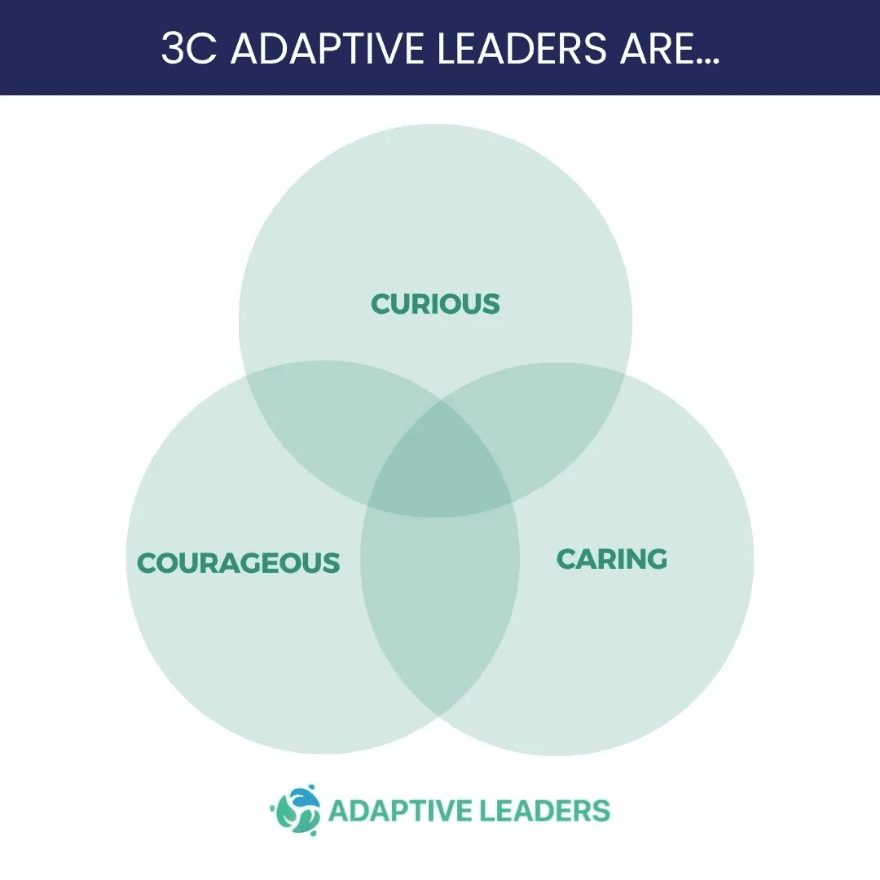
Curiosity
- What is actually on my dread list if I write down everything I’ve avoided for more than a month?
- Which items imply a prediction I haven’t tested, and what evidence would I need to check it?
- What is an embarrassingly small first step I could finish today for the item that takes the most mental energy?
Courage
- Which “important” item on my dread list needs to be challenged as maybe not that important?
- Which conversation have I put off the longest, and what is the first sentence of it?
- What would I do this week if I stopped waiting until I felt ready?
- Where am I being overly courageous and hoping for a big overhaul when a small win would be better than nothing?
Care
- Whose work gets harder, or whose stress goes up, because of what I keep putting off?
- How can I make it safe for my team to tell me what bothers them before it becomes dread?
- How can I give myself a real celebration for each small thing that gets done on this?
Every leader has a factory floor of their own, a place where the mess is easy to ignore and the dread is hard to name. Most of what we dread feels bigger than its first step. You don’t have to fix it this week. Fix one small part. Tomorrow, you’re standing somewhere new.
Adaptive Leader Studio™
This is exactly the sort of exciting, deep work we do with leaders in our Adaptive Leader Studio™. If you’d like to make a fast and lasting change to flex your adaptivity, join us online or in person near you.