An article from our “Adaptive Hacks” series
Have you ever seen the problem become the solution?
The Broken Arm
Tommy runs a small software firm. Last winter he broke his arm snowboarding and could no longer code. This was a disaster because the project pipeline had some demanding deadlines approaching. It wasn’t clear if his business would survive this tragedy without him at the keyboard.
The solution he was forced to adopt was: hire another programmer, even though he felt his business was not ready to support another staff member.
It turned out this was exactly the right decision. Tommy got pulled out of the code and was forced into the strategic level of his own company for the first time in years. The break he dreaded turned into the promotion he never gave himself. Even though on paper (money-wise) the company wasn’t exactly big enough to hire someone else, the shift in Tommy’s role and the success of the new programmer enabled the company to grow much faster than its previous trajectory.
What was forced on Tommy by accident can be a tool in your pursuit of purposeful adaptivity. Specifically, you can practice asking “What if the opposite were true?”
Adaptive Hacks
An “adaptive hack” is a mental shortcut that quickly jolts you out of your default mode of thinking or working and forces you to explore an area previously unknown or off-limits. Think of it like stepping off the well-worn path through the jungle to see if there might be something interesting in the bushes.
Using an adaptive hack doesn’t commit you to doing anything different. That’s why it’s powerful. It’s a pause and a new look to gather information you didn’t previously have.
Then you go on to make a better, more informed decision than you would have.
Tommy actually used this adaptive hack fairly quickly when he broke his arm. Like most of us, his default reaction was, “This is going to be terrible for my business.”
Then he paused and asked the adaptive hack question: “What if the exact opposite were true?” That got further refined to be:
- What if breaking my arm is the best thing for my business?
By exploring that line of thinking, he was able to reframe the hiring decision not as premature but as highly strategic. He also changed how he onboarded this extra programmer not as a temporary solution but as a foundation for the future.
Naming Assumptions
This adaptive hack helps you find and name assumptions. Humans seem to naturally operate under unexamined cause-and-effect rules we’ve never said out loud. For example,
- If I’m late, I’ll look bad.
- If I’m strict, people won’t like me.
- If I try and fail, I’ll lose credibility.
And the list goes on.
Now let’s apply the “extreme opposite” adaptive hack.
- What if being late actually made me look good?
- What if being strict led to people liking me more?
- What if trying and failing boosted my credibility?
There are certainly times those wouldn’t work, but can you see how new possibilities start to arise?
The Wonky Voice
One of our coaches remembers feeling nervous that his voice suddenly wasn’t working well and he needed to walk into a room of leaders at a key client in just a few minutes.
He identified what he was worried about:
- My wonky voice will cause all kinds of problems for my work today.
And then he applied the adaptive hack:
- What if my voice sounding off will improve the work today?
That pause and reframing made all the difference.
Before using the hack, he probably would have walked in and said, “Sorry, my voice sounds off today. I hope it’ll get better soon.” And would have been thinking to himself, “This is terrible, but we’re doing the best we can.”
Instead, he actually said, “Morning everyone. My voice is really weird today. I don’t know why. Does that ever happen to you?”
And immediately the room was sympathetic, with many smiles, nods, and “all the time.” It actually served to reduce the distance between the coach and the leaders. The voice problem made the day better, but it didn’t have to. Purposefully applying the “extreme opposite” line of thinking changed the problem into a solution.
Guard Rails
There are obvious times when asking “what if the exact opposite were true?” won’t work at all. Use your intuition and judgment and don’t fall for ridiculous trains of thought such as:
- What if being rude to customers is the best way to build loyalty?
- What if showing cruelty is actually the kindest thing I could do?
- What if making the investors unhappy is actually a great idea?
These are clearly nonsensical and not useful. There are limits to when this adaptive hack should be used, and you can gut-check them against your own values.
Another way to use this hack responsibly is to keep the 3Cs in mind.
3Cs And The Extreme Opposite Hack
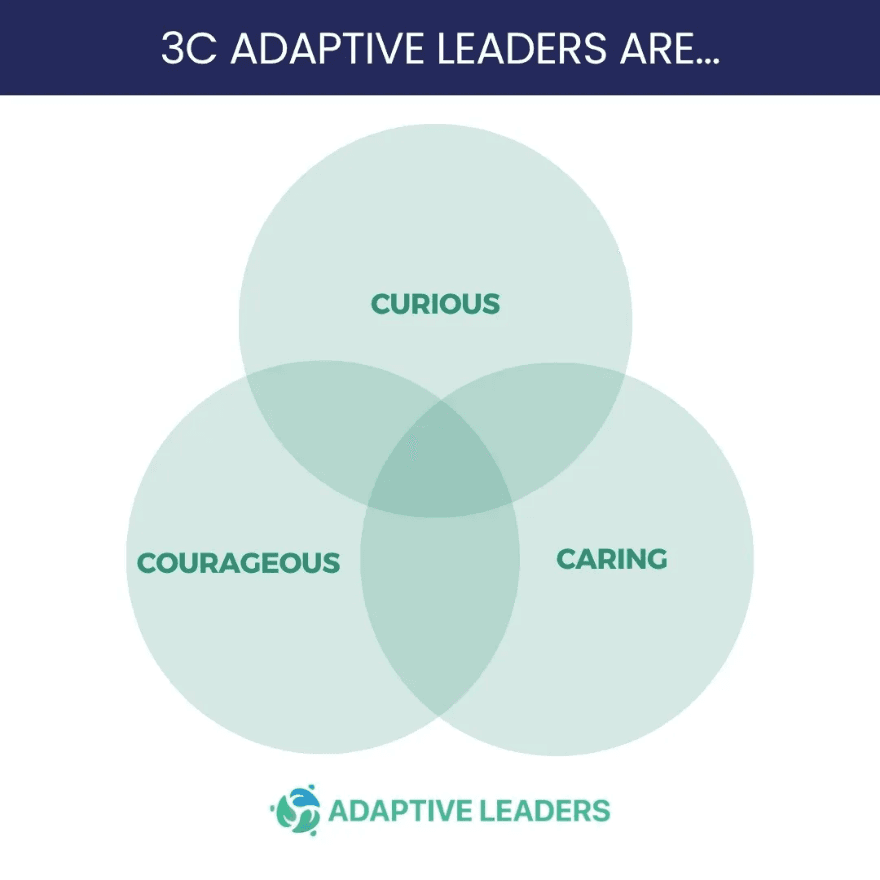
Curiosity
- How can asking about the extreme opposite open up my thinking?
- How might the “bad” thing actually be a stepping stone to success?
Courage
- What would be the cost if I were to test the opposite of my default mode this week?
- What is frightening about exploring extreme opposites?
Care
- How can I make it safe for my people to challenge the team’s default assumptions out loud?
- Who have I written off as “the problem” who might actually be my best source of a solution?
The Adaptive Leader Studio™
This is exactly the sort of practical reframing work leaders do together inside our Adaptive Leader Studio™. If you’d like to build this muscle alongside other leaders working through their own real challenges, join us inside the Studio.