What expectations are you putting on your team because you have always put them on yourself?
A Driven Driver
A leader in a well-known global company was known for his hardworking and results-driven performance. But his supervisor needed him to change how he led his team.
His supervisor told our coach that he focused too much on giving his team goals and tracking them, which was not what his team needed. What this leader needed to do was increase his empathy for his team and develop them as people, not just performers.
When our coach got to know this leader, she and he discovered together that his relentless focus on results was based on the assumption that he needed to bear everyone’s burdens. That had helped him succeed as an individual performer, but not as a leader (see this article for more about that phenomenon).
The EMMA Lens
Just to be clear: we’re not saying he should stop focusing on results. That’s exactly what our Performance Leadership model, EMMA, is for! So, let’s use EMMA to analyze where he went off track.

He had high business Expectations for his team, and they were probably pretty clear. What he’d neglected were his supervisor’s expectations that he would also develop his people rather than just getting them to deliver results. This may actually have been an EMMA failure at his supervisor’s level, but for now we’re going to deal with just this leader.
The Motivations conversation was completely missing. His team felt they were just working for him without any connection to their own motivations. They knew what the leader wanted. But he had no idea what they wanted. In that case, most supervisors assume the standard “carrots” are money and position. But people are motivated by far more interesting things than that. (Our Work Motivations Profile was developed to kick off exactly this conversation.)
Measurements and Accountability were fairly strong with this leader, perhaps even overdeveloped. The cadence of checking in could have been reduced for the same (or better) results. Too often, the more a leader cares about hitting metrics, the more frequently they check on them. Counterintuitively, this can demotivate the team. Better to spend more time on Expectations and Motivations and then co-create the drivers and check-in cadence for maximum results.
Hear our coach Sabine Xie tell part of this story and how she relates to this leader’s achievement focus on Episode 14 of The Adaptive Journey podcast.
Projecting onto Our Team
Research suggests that leaders can repeat the behavior of leaders they have worked under, especially when those leaders are seen as successful (e.g. Tu et al., 2018). In this story, this leader was able to recognize the strong influence of his family’s leadership and values which shaped his value for relentless driving for results.
The problem was that he had projected this same expectation onto his team, who didn’t come from the same background, without considering what they needed.
It is a sobering thought that leaders can project their own background and values onto their teams without realizing the impact on people who have different origin stories. This requires adapting, and focusing somewhere you may not be used to looking.
The 3Cs and Your Expectations
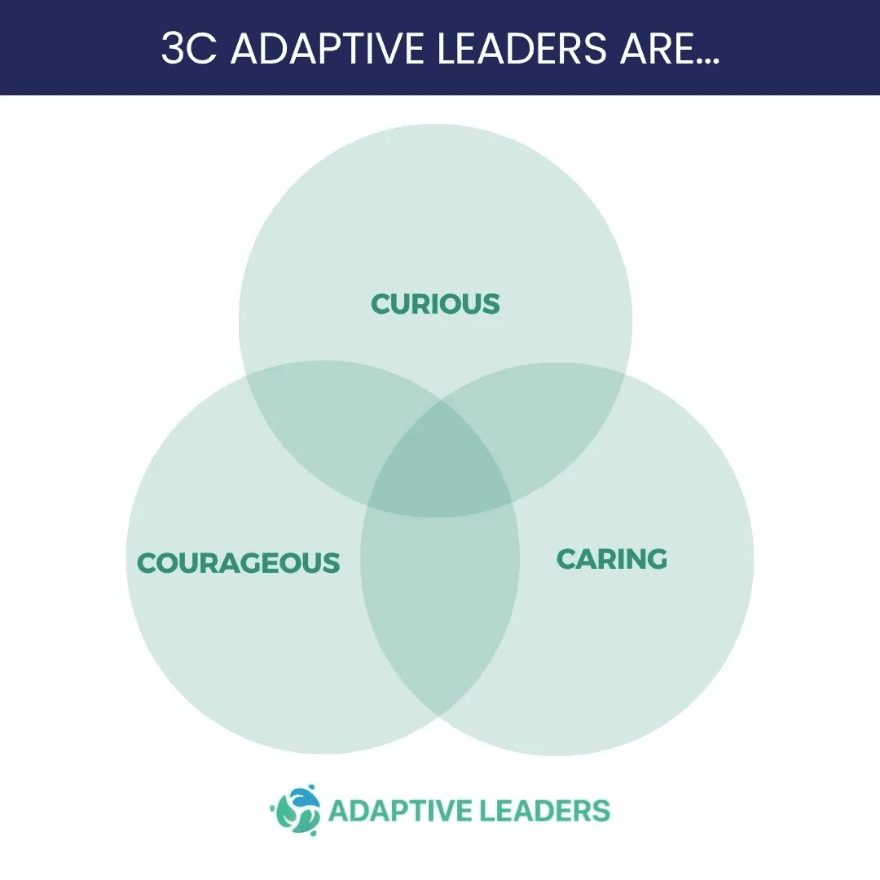
We turn to the 3Cs to break the cycle of projected expectations and reveal better ways to relate as humans, without sacrificing results.
Curiosity
- What am I expecting this person to do that I have not actually discussed with them?
- Where did I learn this?
- What would I call someone who doesn’t share this view?
- What small experiment could help me find out whether a different approach would still produce the results we need?
Courage
- Which expectation do I already know is unreasonable but feel afraid to change?
- What do I need to admit to my team about the pressure I have been putting on them?
- What conversation am I avoiding because it would expose a rule I have lived by for years?
Care
- What might this person be carrying that I have not taken time to understand?
- How can I offer support in a way that helps them take responsibility?
- What support or rest from driving do I need to allow myself in order to break the cycle of projection?
Whatever happened…?
The leader our coach was working with eventually had a “graduation” from the coaching program. His supervisor said, “Wow. He really changed.” The leader’s heart was softer toward his team, and more importantly towards himself. This is what’s possible when the 3Cs get activated and EMMA gets balanced treatment.
The change this leader made became visible in his questions. His people began hearing him ask what they wanted and how he could help. Which questions does your team need to hear from you that they’ve never heard before?
The Adaptive Leader Studio™
Do you want to lead your teams to achieve extraordinary results? Explore the 4 conversations that make that possible by enrolling in our affordable Adaptive Leader Studio™ today.