
How often do you refuse requests at work?
Doing Everyone Else’s Work
A senior HR leader was convinced he needed to spend more time at the strategic level, but couldn’t figure out where that extra time was going to come from.
“I’m already maxed out, and I’m still not finishing all my work,” he told us.
It turned out he needed to stop saying “yes” to every request that came to him.
“I feel like I’m doing everyone else’s work, but never my own,” he reflected.
This was a major adaptive challenge for him: he was well-liked and well-known for getting things done, so saying “no” would rock his view of himself. But he was neglecting what he knew he needed to do: work at the strategic level more.
Strategic Trade-off
“Spend more time on strategy” is one of the most common improvement goals we hear. Leaders who are already struggling to make that shift are saying “yes” too often.
The real challenge isn’t whether to say no. It’s how to refuse assertively without breaking the relationship. The good news is, assertiveness isn’t a fixed trait (Ames et al. 2017). It’s a constant, real-time calibration between getting your own goals met and protecting the relationship with the person standing in front of you. In other words, it’s learnable.
Why We Say “Yes” Too Much
In our experience, we say “yes” because of assumptions we’re making that are often (but not always) true, for example:
- If I say no, they’ll think less of me.
- If I say no, it will cause more problems later.
- If I say no this time, I’ll lose my one shot to prove I can handle it.
- If I don’t do it, it won’t get done right.
- If I’m not endlessly helpful, I’m not good at my job.
- (fill in your own)
As you can see, there are certainly times when those are true. But they’re not always true, and that’s where you need a new strategy.
Negotiate Instead of Refuse
Our suggestion: stop treating every request as a binary yes-or-no, and start treating it as a negotiation. Before your next automatic “yes,” try asking at least one question you don’t normally ask.
In other words, think of requests (whether from a boss or a co-worker) as the beginning of a negotiation, rather than the end of a discussion.
Here’s what that looks like in practice:
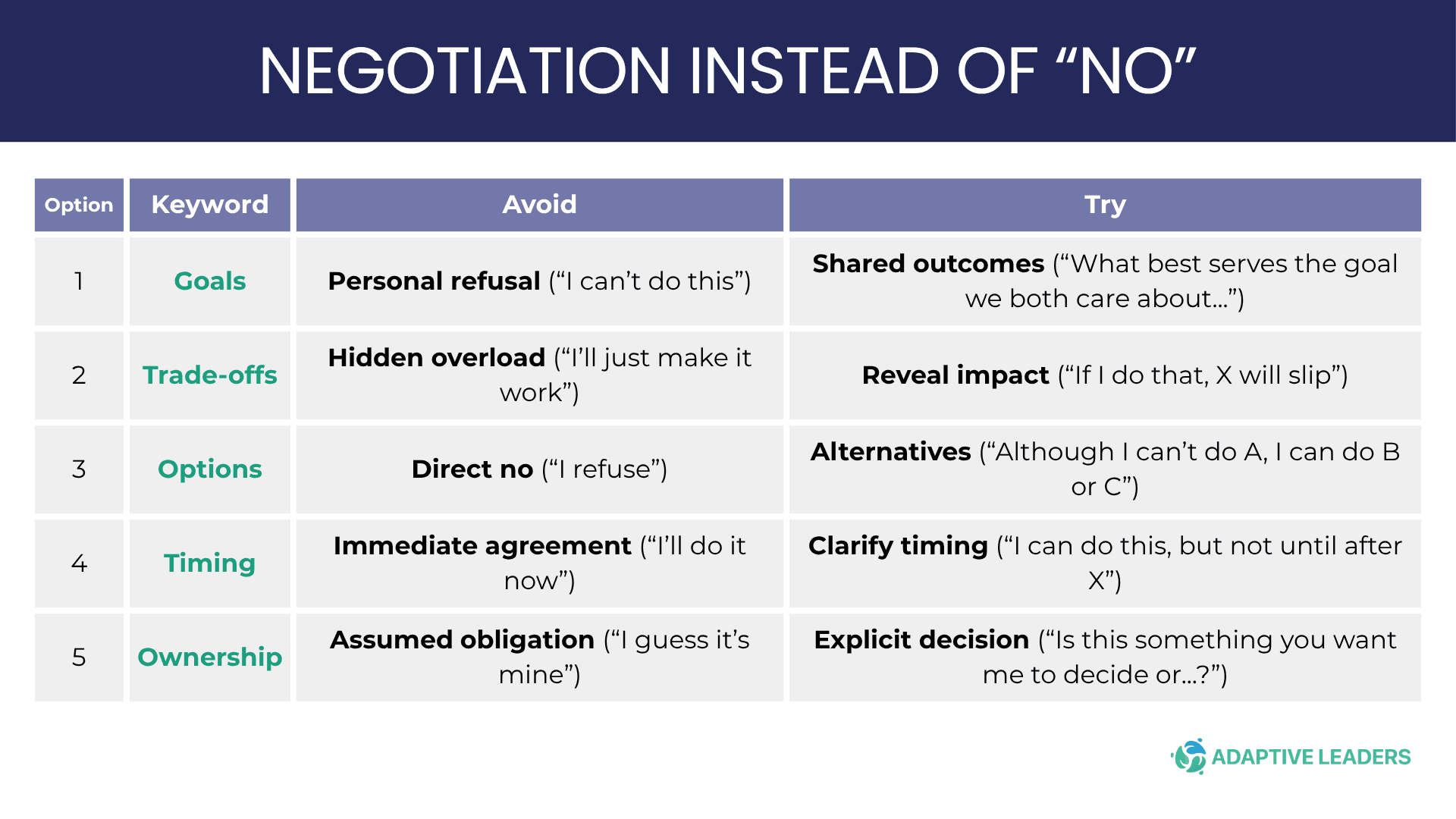
Once you have a bigger repertoire of responses, you can explore the edges of those assumptions that have be making you default to over-committing.
In The Real World
Our HR leader started with just one move: choosing one item from the “menu” above and using it with one person. The one he liked was a variation on #2: “I can take that on, but it means X won’t get done this week. Which do you want?” Within a month, he’d freed up several hours a week, without damaging a single relationship.
Another leader in a different organization said, “That list of options just blew me away.”
“What was it that impressed you about it?” our coach asked.
“Just that there’s hope. I don’t have to always say “yes” to everything!”
And that’s our core message: there is hope. Things don’t have to continue the way they are. You’re more in the driver’s seat than you realized.
Saying “No” and the 3Cs
Curiosity, Courage, and Care power your experiments to say “no” more frequently, gently, and authentically. Here are some questions you can ask yourself as you move forward with this line of experimentation:
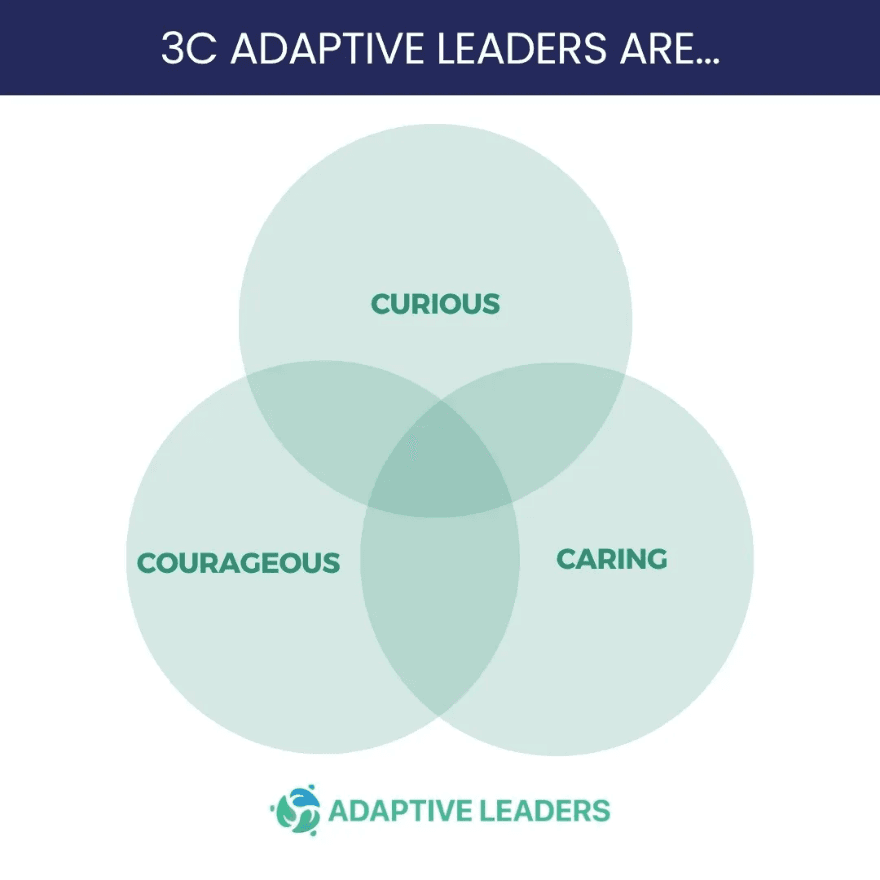
Curiosity
- How often do I say “yes” each week?
- Whom do I agree to help more quickly than others?
- What would I notice if I tracked every “yes” for a week?
Courage
- What’s one question (from the menu above or elsewhere) I could ask before agreeing, instead of agreeing on the spot?
- What alternative could I offer instead of a flat “yes”?
- What would happen if I named the trade-off instead of quietly absorbing it?
Care
- Whose expectations am I protecting by saying “yes” automatically?
- How might saying “no” (gently) be in the other person’s best interest?
- How will saying “no” improve my self-care?
The HR leader in our story didn’t learn to say “no” exactly. He learned to negotiate and lean into the other people’s goals. That usually strengthens relationships, not to mention setting a good example for other over-burdened colleagues around you.
The Adaptive Leader Studio™
Exploring Curiosity, Courage, and Care is a major part of the exciting, deep work you can scale to your whole organization with our Adaptive Leader Studio. Get started today.