How good is your team’s accountability?
The Team Discussion No One’s Having
A frustrated middle-aged manager was talking to us about her organization.
“We have a major accountability problem,” she said.
How is that showing up?
“People aren’t finishing work on time, they’re not hitting their targets, they’re refusing to help each other hit their targets. And managers are not doing anything about any of that. There are just a lot of excuses.”
Yes. That does sound like an accountability problem all right, and she’s not alone. Excuses are one of the main symptoms that you might have an accountability gap.
Quick Diagnosis
You can do this with your team immediately. Ask everyone:
- How good are we at accountability?
(Rate from 1-5, with 5 being “really good”)
You can decide whether you want the results anonymous or not. You can decide what “we” means.
But what you shouldn’t do is offer additional information or define accountability ahead of time. If someone asks, “What do you mean by that?” or wants additional clarification, just reply:
“It’s a deliberately open question.”
When the results come in (which can take 2 seconds), you’ll have plenty of time to ask people what they meant when they answered the question.
It’s such a simple exercise, but so few teams we’ve worked with, across all industries and global markets, address accountability directly like this. They often don’t even open up the topic. One reason: the leader will be implicated.
Leaders Are Falling Short
We define accountability as:
- Accountability = owning the follow-through for commitments
It is the final “rubber meets the road” element in our EMMA model for Performance Leadership, the four keys to improving your team’s performance:
- Expectations
- Motivations
- Measurements
- Accountability
So the definition of an “accountability gap” is:
- Accountability Gap = when follow-through is an assumption, but not a reality
Usually, when working with teams, we find they self-rate on the low side for accountability. Almost without fail, leaders will also tell us this is an area they personally need to improve and hope their organization can improve as well.

Gallup’s most recent data confirms there is a real gap. “Accountability” ranked last in both self-ratings and in managers’ ratings of their direct supervisors across seven leadership competencies. And while all seven showed that people generally rated themselves more positively than their leaders, the self-versus-others delta was smallest for accountability. That means leaders more accurately know they’re bad at accountability than the other 6 (which they’re also kind of bad at).
How good are leaders at the 7 competencies? According to Gallup, they’re worst at accountability:
- Build relationships (best)
- Develop people
- Lead change
- Inspire others
- Think critically
- Communicate clearly
- Create accountability (worst)
Hogan also recently published a study of global respondents about what they most want leaders to be good at. Accountability stood out clearly in the top 5 (page 12):
- Effective communication
- Effective decision-making
- Accountability
- Integrity
- Leadership ability
Why Is Accountability So Hard?
The data is in; your own experience likely confirms it: accountability is hard to do well. But why?
If it’s arguably the most absent tool for improving performance, which then drives engagement, why are so few leaders doing it effectively?
There are two important reasons:
1. Accountability is part of a system
Accountability is part of a broader system for performance leadership, and cannot stand alone when the other pieces are missing.
Accountability appears last in EMMA for a reason. Remember the story of the frustrated leader? It turned out that people were not entirely clear on other elements of EMMA before reaching the accountability stage, making it virtually impossible to hold them accountable.
For example, the issue of people not finishing work on time was complicated by the fact that not everyone shared the same definition of “on time” or even “finished.”
If expectations are unclear, if you haven’t tapped into people’s existing Motivations, and you’re not measuring the right things, then accountability will break down. You may not even attempt at all.
2. Accountability makes us uncomfortable
Doing accountability badly is what’s actually uncomfortable, but for many leaders, it’s the only model they’ve seen.
What bad accountability looks like:
- Barking
- Blaming
- Excusing
- Guessing
- Hoping
- Being hot and cold
- Hypocrisy
- Judging
- Punishing
Let’s not have that. But even when leaders say they want to improve accountability, fears still keep them from making changes.
- “I don’t want to demotivate them.”
- “I might damage the relationship.”
- “They’re already overwhelmed.”
- “I could be wrong or missing some important information.”
- “This might not be within their capacity.”
Those are all reasonable fears, and some of them might be true. But let’s talk about the last one for a moment because it’s the most exciting one to test.
Over more than a decade of working with teams, we’ve consistently found that leaders underestimate people’s capacity. One exciting reason to improve accountability is that they might be highly capable, but are holding back because of your approach.
Listen to the related podcast episode below.
3Cs and the Accountability Gap
To make lasting progress in closing accountability gaps, you’ll need your 3Cs operating at a higher level.
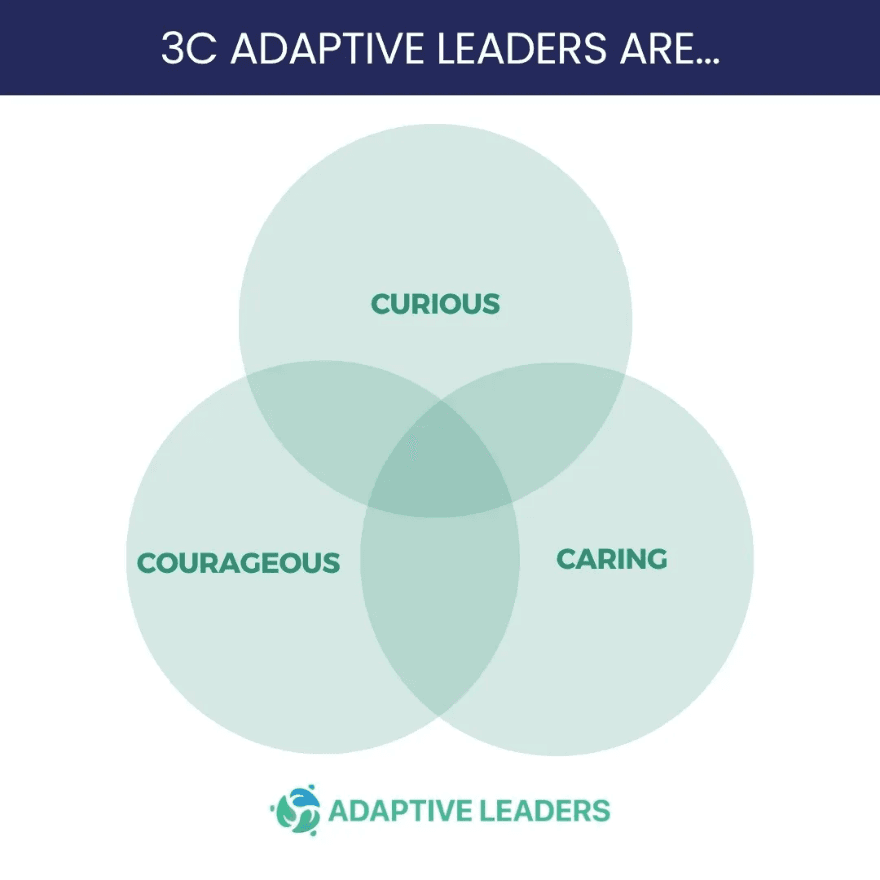
Here are some questions to guide your adaptive growth:
Curiosity
- Where is the Accountability Gap for me?
- What would happen to my team or organization if we made even a 10% improvement in accountability?
- Which areas of EMMA are missing before I can improve accountability for a specific person?
Courage
- What is stopping me from asking the question at the very top of this article?
- If I knew that accountability would strengthen, not weaken, my relationships, how would that empower me to move forward?
- How much counter-cultural tension am I willing to endure for the sake of improving performance?
Care
- How could my holding someone accountable make someone’s life better?
- What nuance can I bring to individual accountability that will show my care for them?
When you lead performance (EMMA) with your 3Cs, you’ll find you can not only practice accountability more effectively, but you can also become a leader who is not encumbered by the same worries that have held you in place thus far.
You can become the kind of leader that leans into accountability rather than away from it, with less stress, less wasted energy, and less heartache than ever before. We promise. We’ve seen it.
The Adaptive Accelerator™
This is exactly the sort of exciting, deep work we do with leaders in our free 1-hour Adaptive Accelerator™ program. If you’d like to make a fast and lasting change to flex your adaptivity, join us online or in person near you.
Next Steps?
Not quite ready for the whole experience? Try our 3-minute free Adaptive Snapshot for immediate insight and specific advice on your own 3Cs.